IMMERSE! Local Students Take Over the Putnam

A Week Away From the Classroom

The Putnam is known for engaging the Quad Cities community via special opportunities to question, learn, and grow. One educational program that emphasizes this mission is IMMERSE.

IMMERSE focuses on 3rd- 6th graders primarily from Title I schools- those the federal government has identified as having especially large percentages of low-income students. Since its inception in 2017, we have worked with multiple districts, including Davenport, East Moline, and Rock Island. The program empowers teachers to integrate our myriad of resources into their regular curriculum and then bring their students to attend school at the museum for a week at no cost to the school or students.

Empowering Teachers

IMMERSE allows teachers to expand their lesson plans and integrate more hands-on learning and student-led discussions. To date, the program has served 1000+ students. Two fully equipped Putnam classrooms serve as home base for the classes, and a low ratio of students to chaperones allows for small group learning throughout the museum.

The Curriculum 

This fall, we have served 14 classes, focusing on scientific discovery and historical knowledge— inspiring thoughtful discussions. Each week, IMMERSE classes engage with a combination of programs led by our education department such as Weather Rocks! and Science Alive presentations; curator presentations; and experiments designed to be taught by the teachers themselves. To end the week, the students take in an educational film in our Giant Screen Theater, providing a “being-there” learning experience.

When asked about the curator presentations; specifically “Artifact Identification”, Putnam Curator of History and Anthropology Christina Kastell explained that it teaches children to be observant and think critically. Once they make their conclusions regarding the item they are analyzing, they present their findings in front of their peers. “This presentation is special to me because of the creativity of the students’ ideas,” Kastell reports.

Pull quote "The majority of kids who come have not been here before, this may be their only opportunity to come experience all the Putnam has to offer."

Education at the Putnam

“My favorite thing about IMMERSE is that they are here for a full week,” says Lead Putnam Educator, Lakin Sheeder. “The majority of kids who come have not been here before, and this may be their only opportunity to come experience all the Putnam has to offer.” The engagement and excitement of the students is palpable as soon as they walk through the doors. Excited chatter and laughter fill the museum, and pencils work hard to keep up with the information students are taking in.

At the end of each week, we receive anonymous surveys from teachers, chaperones, and students. When asked what their favorite part of the museum was, numerous respondents mention our newly re-imagined regional history exhibit, Common Ground. “I love Common Ground because we can share our stories,” reported one child.

Learning Through Exhibits

Putnam Education Director Steve Mielenhausen notes that when he was designing activities related to this exhibit, he wanted to emphasize student-led discussions, creating “experts” who share their newfound knowledge with each other. The 16 questions he created for one activity send students “searching” the exhibit, exploring and learning organically.

One of the most valuable aspects of this exhibit is its honesty. “I didn’t want to shy away from controversy,” says Mielenhausen. It is important to see the “growth of the community based on the response to adversity.”

Re-Igniting Curiosity

Participating teachers are grateful for IMMERSE. “Thank you for
making it possible for our 3 classes/84 students to have this amazing experience!… We are thankful for the opportunity to be a part of IMMERSE!” said one.

Students also rave about the experience, describing their love of presentations featuring fireballs and designing their own rockets. One student confessed, “I was so nervous when our teachers told us we were going (to the Putnam) for a week. But I had fun. Learning was fun!”

Donor Spotlight: Amy & Ron Nimmer

PRIORITIZING EDUCATION

This Donor Spotlight goes to Amy and Ron Nimmer. Their involvement with the Putnam began with their grandchildren.

For the Family

Amy recalls, “The Putnam became the favorite destination for all four of our grandkids. There have been so many great hands-on learning experiences. There’s so many intriguing things to discover, and the museum building itself is exciting to explore”. She recalled an evening scavenger hunt by flashlight, which was a huge hit with their family.

Their now 15-year-old granddaughter had her 4th birthday party at the museum. They remembered Putnam staff providing cool chemistry-related activities and demos. Of course, the kids loved it.

The Putnam Power Circle

However, it’s not just the benefits the Putnam provides their family that motivate the Nimmers. As part of the Putnam Power Circle, their generosity is driven by something greater. “Our passion is education, especially for kids who don’t get as many opportunities for enrichment,” says Amy. “The Putnam impacts so many kids. It does so much to get kids interested in science, technology, engineering, and math. Further, it provides exposure for kids of all income levels and backgrounds. There’s activities where they’re building something or they’re working as a team in a fun way on crucial subjects.”

Putnam Donor Spotlight: Amy & Ron Nimmer
Amy & Ron Nimmer

The Power of Collections

Amy and Ron believe there’s many reasons for the QC community to support the Putnam. When asked about the museum’s 250,000-item collection, Amy says, “The artifacts are incredible! It’s eye-opening to go through the collection to see the quality and quantity of items. The Putnam stewards this for us and future generations of Quad Citians.” 

Regarding recently opened permanent galleries, such as the inclusive regional history exhibit and World Culture Gallery, Amy remained hopeful about the future. She continued, “The Putnam is a hidden gem that has been reinventing itself. Of course, a lot of people don’t realize that. When you’re not opening a glitzy new building, it can be hard to get the word out about the amazing changes taking place.”

Recently, she brought a group of friends on a tour with Putnam CEO Rachael Mullins. “Everyone raved about it,” says Amy. “We need to get more people into the museum who can help spread the news. You have to see it to believe it!” 


Volunteer Application Form

Get Started at the Putnam!

Use this volunteer form to begin the process today. You can view our volunteer opportunities here.

Volunteer Form
Name
Name
First
Middle
Last
Are You 18 Years or Older?
Education: Highest Level Completed
Employment: Please Check All that Apply
Volunteer Experience: Check All That Apply
Volunteered Elsewhere (If yes, list organizations below)
Express Interest by Putnam Department: Please check all that interest you to receive more information:
Education
Collections
Marketing & Membership
Visitor Services
Exhibits
Building & Grounds

Please Read and Sign:

I certify that the facts contained in this application are true and complete to the best of my knowledge. I agree to comply with the policies and procedures, as well as safety practices, in all areas of the Putnam Museum and National Geographic Giant Screen Theater.

I authorize the Putnam Museum to check and verify all information on this application. In order to serve the best interest of Museum visitors, the Putnam Museum will conduct a criminal background check on all volunteers. I fully release references, employers and the Putnam Museum and from any liability resulting from the verification process. I have read, or have had read to me, and understand the above statement.

Summer STEAM Half-Day Camps

Get Ready For STEAM Fun!

Are you ready for exciting and educational summer camps? Look no further than our STEAM Camps for students in 4-8 grades! Led by the amazing Sam McCullum from STEAM On Wheels, participants will have the opportunity to explore the latest in 3D pen technology, engineering, tech art and more!

Get ready to unleash your creativity and imagination in a fun and collaborative environment! Don’t miss out on this incredible opportunity to learn, grow, and have a blast. Let the STEAM adventures begin!

Grades 4-8
Three Options for week-long half-day camp (see dates below)
All Camps 9 AM -12 PM
(Drop off 8:45-9 AM)
(Pick up 11:45 AM -12 PM)

These camps are need based and offered at NO COST to qualified participants.

Call 563.336.7290 to get signed up today!

STEAM Half-Day Camps

Wizards & Blocks: A STEAM Adventure Camp

June 17-21, 9-12pm, Max 20 Campers
This summer, brew up some fun with cool chemistry projects inspired by wizards and construct mega-structures in Minecraft. Perfect for young wizards and master builders ready for an adventure! It’s where science meets sorcery and creativity knows no limits.

3D Doodles & Stop-Motion Stories Camp

July 8-12, 9-12pm, Max 20 Campers
Ready to draw, animate, and be amazed? At our camp, you’ll use 3D pens to draw amazing creations that pop right off the page. Then, we’ll dive into the world of stop-motion animation, turning your 3D masterpieces into
characters in your very own animated tales.

Engineering Adventures & Fix-It Missions

August 5-9, 9-12pm, Max 20 Campers
This camp is all about hands-on fun, from constructing imaginative projects to diving into the mechanics of how things work—and learning how to fix them when they don’t. Campers will become junior engineers and repair experts, tackling challenges that teach them to design, build, and think outside the box.

Putnam Education

You can view our other educational offerings here

Volunteer Interest Sign Up!

Begin your journey at the Putnam Museum and Science Center by becoming a volunteer! Your time and energy improves our museum and the experience for visitors.

Thank you for making a difference in your local community.

Volunteer Interest Sign Up!
Volunteer Interest Area
putnam volunteers

Salón de los Mamíferos

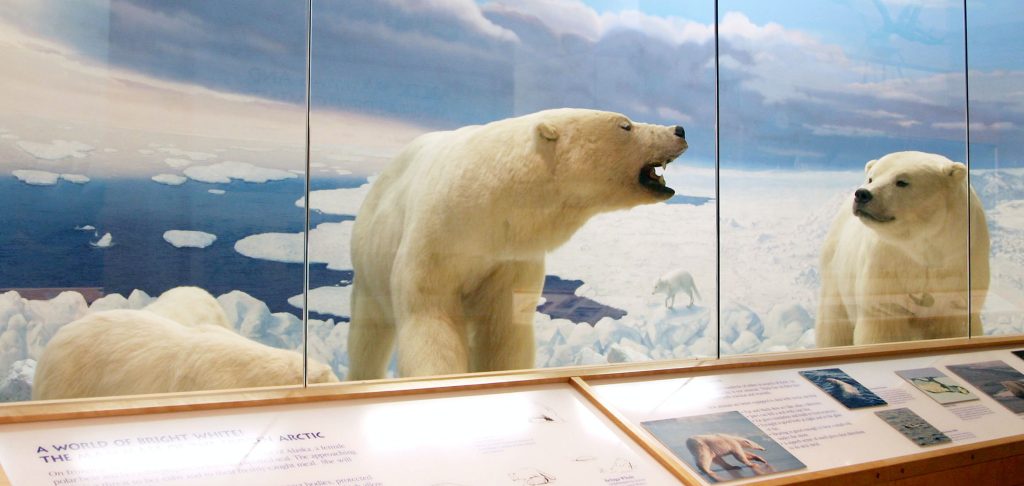
Hall of Mammals exhibit. A family of polar bears in an arctic diorama with icebergs and an arctic fox. Sala de los Mamíferos

Aprenda más sobre la Sala de los Mamíferos en el Museo Putnam. 

Osos Pardos y Osos Polares

Los osos pardos (Ursus arctos) y los osos polares (Ursus maritimus) son especies estrechamente relacionadas. A pesar de esto, los dos difieren notablemente en su ecología, características físicas y comportamiento. Por ejemplo, los osos polares viven casi exclusivamente de una dieta de focas, mientras que los osos pardos comen casi todo lo que encuentran: plantas, animales (incluidos insectos), etc.
 
La evidencia genética nos dice que los osos polares evolucionaron a partir de los osos pardos hace tan solo 400,000 años, y la evidencia fósil confirma que los osos polares se adaptaron a la vida marina hace 125,000 años. Como tales, los osos polares son un notable ejemplo de rápida evolución.


Por otro lado, el flujo de genes entre las dos especies ha continuado a lo largo de su evolución. De hecho, cuando las dos especies se entremezclan, pueden producir descendencia viva (pizzlies o nanulak y osos grolar o aknuk), y estos híbridos también pueden reproducirse.
 
¿Dónde deja esto a los osos polares? ¿La continua disminución del hielo marino hará que estas dos especies interactúen cada vez con más frecuencia? ¿Se convertirán los híbridos en la norma? ¿Se forzará a los osos polares a una dieta más basada en la tierra? Y, de ser así, ¿qué efecto tendrá tal cambio en la dieta en sus especies de presas normales?
 
Estas son solo algunas de las muchas preguntas que se hacen los conservacionistas a medida que cambia el Ártico.

Oso Polar (Ursus maritimus)

Estado: Amenazado (EE. UU.)
En los Estados Unidos, los osos polares están protegidos por la Ley de Protección de Mamíferos Marinos, que prohíbe la captura de todos los mamíferos marinos. Se clasifican como mamíferos marinos debido a su dependencia del hielo marino, el agua de mar congelada que flota en la superficie del océano.
 
¿Dónde viven?
Hay diecinueve poblaciones de osos polares distribuidas por el Ártico en Alaska, Canadá, Groenlandia, Noruega y Rusia. En los EE. UU., Hay dos poblaciones que se monitorean: el sur del mar de Beaufort y las poblaciones del mar de Bering / Chukchi.
 
A partir de 2020, la población de estos se estimó en 4.000 osos.
 
Amenazas a las poblaciones:
La principal amenaza para los osos polares en la actualidad es la pérdida del hábitat del hielo marino debido al cambio climático. La contaminación, el aumento del tráfico marítimo y el desarrollo industrial (especialmente el petróleo y la minería) plantean amenazas adicionales.

Adaptaciones

Los osos polares se separaron de los osos pardos hace unos 400,000 años. Ese es un período de tiempo muy corto en términos evolutivos, especialmente si se consideran los principales cambios que la especie tuvo que sufrir para sobrevivir en el Ártico. Muchas de estas adaptaciones son únicas.
 
El abrigo del oso polar:
 
Los osos polares parecen blancos, pero eso se debe a que los pelos individuales del pelaje son claros y huecos. Dispersan y reflejan la luz.
 
Cada cabello también actúa como un tipo de trampa de radiación ultravioleta que conduce los rayos UV a la piel del oso, que en realidad es negra. Los pelos atrapan la luz proveniente de todas las direcciones, lo que hace que el pelaje sea increíblemente eficiente para convertir los rayos del sol en calor utilizable.
 
Dato curioso: los investigadores canadienses descubrieron que no podían usar fotografías aéreas y infrarrojas normales para detectar osos polares. Los osos se mezclaron tan bien con el entorno que no eran visibles. Y su piel proporcionó tanto aislamiento que no emitieron ninguna señal de calor. Los biólogos terminaron usando fotografías ultravioleta para obtener cifras del censo.

Comida para el pensamiento

A diferencia de otros osos, el oso polar es casi exclusivamente carnívoro y su principal presa es la foca anillada. Sin embargo, como la mayoría de los grandes carnívoros, los osos polares son oportunistas y comerán lo que puedan encontrar, incluidos cadáveres de ballenas varadas, peces e incluso cangrejos. Cuando son llevados a tierra por el deshielo, los osos deambularán tierra adentro y comerán prácticamente cualquier cosa comestible. Desafortunadamente, eso incluye hurgar en vertederos de desechos, lo que a menudo conduce a interacciones indeseables con los humanos.
 
Una dieta alta en grasas:
 
La dieta preferida de los osos polares son las focas: focas anilladas, focas barbudas e incluso morsas jóvenes. La foca manchada en el diorama es del mar de Chukchi. Las focas proporcionan a los osos una dieta grasosa que es esencial para acumular reservas de grasa de los osos para el aislamiento y aumentar su flotabilidad. Hasta el 50 por ciento del peso de un oso polar puede provenir de la grasa.
 
¿Cómo sobreviven con una dieta tan alta en grasas sin obstruir sus arterias?
 
Los osos polares han sufrido cambios genéticos que les permiten procesar grandes cantidades de grasa sin sufrir los devastadores efectos de las enfermedades cardíacas. Por ejemplo, un cambio en un gen específico aumentó su capacidad para mover el colesterol del torrente sanguíneo al interior de las células. Al almacenar grasa en las células, reducen el riesgo de arterias obstruidas y ataques cardíacos.

Foca manchada (Phoca largha)

El sello que aparece en el diorama es un sello manchado. Estas focas reciben su nombre de las manchas oscuras esparcidas sobre sus cuerpos grises. Están estrechamente relacionados y a menudo se confunden con las focas de puerto.
 
Estado: Amenazado (EE. UU.)
Al igual que el oso polar, las focas manchadas están protegidas por la Ley de Protección de Mamíferos Marinos. Actualmente, no hay números de población precisos disponibles para la especie.
 
¿Dónde viven?
Las focas manchadas viven en el Océano Pacífico Norte principalmente a lo largo de las áreas de la plataforma continental de los mares de Beaufort, Chukchi, sureste de Siberia Oriental, Bering y Okhotsk.
 
Amenazas a las poblaciones:
Estas focas están asociadas con el hielo marino principalmente durante la reproducción y la muda, por lo que cualquier pérdida de hielo durante esos momentos puede tener un impacto significativo en la supervivencia de la especie. La apertura de las rutas marítimas del Ártico debido a las pérdidas proyectadas de hielo marino también puede representar una amenaza. De manera similar, un mayor desarrollo de petróleo y gas en alta mar podría afectar a las poblaciones.

Foca anillada ártica (Phoca (pusa) hispida)

Las focas anilladas son las más pequeñas y comunes de las focas árticas. Reciben su nombre de los anillos de colores claros que están esparcidos sobre el cabello más oscuro de sus espaldas.
 
Estado: Amenazado (EE. UU.)
Las focas anilladas están protegidas por la Ley de Protección de Mamíferos Marinos. Hay cinco subespecies reconocidas de focas anilladas, incluida la población ártica, y todas están clasificadas como en peligro o amenazadas según la Ley de especies en peligro de extinción. El tamaño de la población estimada de la foca anillada del Ártico es de más de 300,000 individuos.
 
¿Dónde viven?
Estas focas se encuentran en todos los mares cubiertos de hielo del hemisferio norte e incluso en algunos lagos de agua dulce.
 
Amenazas a las poblaciones:
Debido a que dependen del hielo marino para su sustento durante todo el año, la pérdida de la capa de hielo debido al cambio climático es la amenaza más importante a la que se enfrentan en la actualidad.

Pérdida de hielo marino

Los osos polares del diorama procedían de la región del mar de Chukchi, que alberga una población de osos polares compartida por Estados Unidos y Rusia. Un informe de 2018 sobre el estado de esa población plantea las dificultades para comunicar qué efectos puede tener el cambio climático en las poblaciones del Ártico. En este caso, los osos parecen mantenerse firmes con una población de unos 3.000 osos a pesar de gastar aproximadamente un mes menos al año cazando en el hielo marino de la región en comparación con hace 25 años.
 
¿Cómo es eso posible?
 
Primero, el Ártico es un ecosistema complejo. A diferencia de gran parte del resto del Ártico, la extensa plataforma continental de Chukchi ha creado un hábitat de aguas poco profundas, biológicamente rico, lo que significa que es un lugar realmente bueno para cazar focas. En otras palabras, la pérdida de hielo marino en el área aún no se ha traducido en una pérdida significativa de oportunidades de caza para los osos. Eso no significa que los osos Chukchi estén a salvo del cambio climático; La pérdida continua de hielo marino tendrá un efecto negativo incluso en esta población con el tiempo.
 
En segundo lugar, debido al lugar donde viven y su capacidad para viajar miles de millas, estimar el tamaño y el estado de la población puede ser un verdadero desafío. Si bien el informe de 2018 proporciona una línea de base sobre el tamaño y el estado de la población, es solo el primer paso para comprender la complejidad de la relación de esta población con su entorno cambiante.

Artículos creados por gente indígenas del Ártico

1. Zapatos de nieve
Colección Pawlias, de principios a mediados del siglo 1900.

2. Parte de un taladro de proa de Alaska decorado con bordes horizontales de hombres en botes y con dos cazadores con armas y una ballena a la derecha.
Colección G. R. Putnam, c. 1897.
 

3. Gafas de nieve que se utilizan para proteger al usuario del resplandor de la nieve.
Colección conmemorativa de B.J. y Mabel Palmer.

4. Modelo de kayak de Groenlandia, completo con cazador y su equipo.
Carl Andresen, finales de 1800 – principios de 1900.

5. Máscara de Yup’ik (posiblemente un sello).
Colección G. R. Putnam, c. 1897.Animales del Ártico

Clave de identificación:
1. Buey almizclero
Ovibos moschatus
 
2. Foca anillada
Phoca (pusa) hispida
 
3. Zorro ártico
Vulpes lagopus
 
4. Lobo ártico
Canis lupus arctos
 
5. Narval
Monodon Monoceros
 
6. Ballena beluga
Delphinapterus leucas
 
7. Morsa
Odobenus rosmarus

Oso Pardo (Ursus arctos)

Estado: dependiente de la ubicación
Aunque está catalogado internacionalmente como una “especie de menor preocupación”, muchas poblaciones localizadas están amenazadas o han sido exterminadas. Alaska es el hogar de más del 98 por ciento de la población estadounidense de osos pardos. A diferencia de los 48 estados más bajos, la población de Alaska se considera saludable y productiva.
 
¿Dónde viven?
Los osos pardos se distribuyen por la parte norte de gran parte del hemisferio norte.
 
Amenazas a las poblaciones:
La caza furtiva y la pérdida de hábitat son dos de las principales amenazas para las poblaciones de osos pardos en todo el mundo.

Oso Kodiak (Ursus arctos middendorffi)

El oso Kodiak es una subespecie de oso café que vive exclusivamente en las islas del archipiélago Kodiak frente a la costa suroeste de Alaska. Estos osos son más grandes que la mayoría de los osos cafés del continente; los machos pueden medir más de 10 pies de altura sobre sus patas traseras.
 
Este oso puede ser familiar para algunos residentes de Quad City. Pasó muchos años en exhibición en Thompson Family RV en Davenport.

World Culture Gallery

Learn About World Cultures through Artifacts

The World Culture Gallery hosts an array of incredible artifacts. Many of these were collected and donated by world travelers from the Quad Cities, who sought to help the community learn about other ways of living through the unique objects found across the world. 

You can read more about the artifacts here

As part of the World Culture Gallery, we have a rotating exhibit which focuses on a more specific section of the world and expands our understanding of it.

World Culture Gallery Artifacts

Gain extra insight into our World Culture gallery’s artifacts!


Section 1

① Temple Guardian Statues, Japan

18th Century CE (Common Era), Tokugawa Dynasty
Donated by Charles Ficke

Guardians of the Buddhist faith, these warrior figures are called Nio Statues. They stood to either side of the temple entrance gates, looking on all who passed within. On the right, Guhyapāda, is a symbol of violence. He holds a diamond shaped club and his mouth forms the sound “a,” the sound Buddhists believe you are born saying. The figure on the left is Nārāyana. Symbolizing strength, his mouth forms the sound “hūm,” the sound Buddhists believe you die saying. Together, the sounds make the word “Aum,” meaning “The Absolute” in Sanskrit.


Estatuas del guardián del templo, Japón,

Siglo 18 EC (Era Común), Dinastía Tokugawa
Donación de Charles Ficke

Estas figuras de guerreros se llaman estatuas de Nio, los guardianes de la fe budista. Se pararon a ambos lados de las puertas de entrada del templo budista, mirando hacia abajo a todos los que pasaban dentro. El guardián de la derecha es Guhyapāda, símbolo de violencia. Sostiene un garrote en forma de diamante y su boca forma el sonido “a”, el sonido que los budistas creen que se dice que naces. La figura de la izquierda es Nārāyana y simboliza la fuerza. Su boca forma el sonido “hūm”, el sonido que los budistas creen que dices te mueres. Juntos, los sonidos forman la palabra Aum, que significa Absoluto en el idioma sánscrito.

② Reproduction Ancient Egyptian Leopard Chair

1920s CE (Common Era)
Donated by the B.J. and Mabel Palmer Estate

This chair is styled in the tradition of ancient Egyptian furniture and is covered with real leopard skin. According to the Palmers, this piece of furniture was purchased in Egypt in 1923. They were treated to a private tour of King Tut’s tomb by Howard Carter. While there, Carter handed Mabel Palmer a ushabti figure. Supposedly, this figure was from the tomb and for her to keep!

Reproducción de Silla de Leopardo Egipcio Antiguo
Década de 1920 EC (Era Común)
Donación de B.J. y Mabel Palmer Estate

Esta silla está diseñada según la tradición de los muebles del antiguo Egipto. Está cubierto con piel de leopardo real. Según los Palmer, este mueble, junto con varias otras piezas, se compraron en Egipto cuando los Palmer estaban de visita en 1923. Howard Carter les invitó a un recorrido privado por la tumba del rey Tut. Mientras estaba allí, Carter le entregó a Mabel Palmer una figura de ushabti supuestamente de la tumba para que ella la guardara.

③ Basketry Dance Costume, Sepik River Region, Papua New Guinea

C. 1950s CE (Common Era)
Donated by Monseigneur Michael Schwarte

This costume was made by a boy undergoing his transition to adulthood. It is marked by scarification of his back to look like the hide of a crocodile. While healing, he made this with his uncle. The boy was on the inside of the costume and passed one end of the plant fiber to his uncle on the outside, who wove it back in to the boy.

Traje de baile de cestería, región del río Sepik, Papua Nueva Guinea
C. 1950 EC (Era Común)
Donación de Monseigneur Michael Schwarte
Este disfraz fue hecho por un niño en proceso de transición a la edad adulta. Está marcado por la escarificación de su espalda para parecerse a la piel de un cocodrilo. Mientras se curaba, hizo esto con su tío. El niño estaba en el interior del disfraz y le pasó un extremo de la fibra vegetal a su tío en el exterior, quien se lo devolvió al niño.
 

④ Porpianong (Spoonbill Bird Carving), Senufo People, Ivory Coast, Africa

C. 1845 CE (Common Era)

Donated by Thomas Figge

This figure was carved by a member of the Senufo Tribe of the Ivory Coast. It is called a Porpianong and is a representation of the Spoonbill bird, the mythical founder of the Senufo Tribe. It is a symbol of fertility with a phallic beak and swelling stomach. The Spoonbill bird mates for life and shares equally the tasks of raising the chicks. It protects the nest by spreading it wings over the chicks, the protective stance shown in this figure. The statue is used as part of men’s funerary rituals. Boys show their strength by carrying the large statue on their heads from the village to the site of rituals.

Porpianong (pájaro espátula talla), pueblo Senufo, Costa de Marfil, África
C. 1845 EC (Era Común)

Donado por Thomas Figge

Esta figura fue tallada por un miembro de la tribu Senufo de Costa de Marfil. Se llama Porpianong y es una representación del pájaro spatula talla, el mítico fundador de la Tribu Senufo. Es un símbolo de fertilidad con pico fálico y estómago hinchado. El pájaro spatula talla se aparea de por vida y comparte igualmente las tareas de criar a los polluelos. Protege el nido extendiendo sus alas sobre los polluelos, la postura protectora que se muestra en esta figura. La estatua se utiliza como parte de los rituales funerarios de los hombres. Los niños muestran su fuerza llevando la gran estatua sobre sus cabezas desde el pueblo hasta el lugar de los rituales.

⑤ Cloisonné Ice Air Cooler, China

18th Century CE (Common Era), Qing Dynasty

Donated by the B.J. and Mabel Palmer Estate

This ice chest was created for use by the Emperor and his household in the Forbidden City, Beijing, China. The presence of phoenix birds, the symbol of the Empress, among the decoration on the box suggests that this was for her use. The chest was filled with ice and placed in rooms at the palace to cool the air. During the winter, blocks of ice were cut on the Inner Golden River and stored in 5 ice vaults near the Gate of the Great Ancestors in the Forbidden City.

Enfriador de aire de hielo cloisonné, China
Siglo 18 EC (Era Común), Dinastía Qing
Donación de B.J. y Mabel Palmer Estate
Esta hielera fue creada para ser utilizada por el Emperador y su familia en la Ciudad Prohibida, Beijing, China. La presencia de aves fénix, el símbolo de la Emperatriz, entre la decoración de la caja sugiere que esto era para su uso. El cofre se llenó de hielo y se colocó en habitaciones del palacio para enfriar el aire. Durante el invierno, se cortaron bloques de hielo en el Río Dorado Interior y se almacenaron en 5 bóvedas de hielo cerca de la Puerta de los Grandes Ancestros en la Ciudad Prohibida.

⑥ Carved Meeting House Panel, Maori People, New Zealand

19th Century CE (Common Era)
Donated by the B.J. and Mabel Palmer Estate

This carved wooden panel, called a poupou, was placed on the veranda of a Maori meeting house (wharenui). It is one of a collection of 5 panels, each of which was carved to represent the lineage of the specific male carver. The panels are treated as if they are the ancestors themselves. The meeting house was used for funerals, political meetings, entertaining and other social events. It was considered a sacred space dedicated to the deity Rongo, the god of agriculture.

Panel de la casa de reuniones tallada, pueblo maorí, Nueva Zelanda
Siglo XIX EC (Era Común)

Donación de B.J. y Mabel Palmer Estate

Este panel de madera tallada, llamado poupou, se colocó en la terraza de una casa de reuniones maorí (wharenui). Es uno de una colección de 5 paneles, cada uno de los cuales fue tallado para representar el linaje del tallador masculino específico. Los paneles se tratan como si fueran los propios antepasados. La casa de reuniones se utilizó para funerales, reuniones políticas, entretenimiento y otros eventos sociales. Se consideraba un espacio sagrado dedicado a la deidad Rongo, el dios de la agricultura.

Section 2


① Antelope Carving, Bambara People, Mali, Africa

20th Century CE (Common Era)

Donated by Richard and Anne Kauzlarich

This roan antelope carving, called a chiwara, was worn as a mask for dancing and rituals, usually associated with agriculture. The short legs are like the aardvark, who burrows in the earth like the farmer. The tall horns are like the millet stalks. The wooden carving is worn on the head of a person dressed in raffia to symbolize a bountiful harvest. The Bambara People of Western Africa were the royal members of the Mandinka People. They originated the Mali Empire, dating back to the 13th Century.

Talla de Antílope, Gente Bambara, Malí, África
Siglo 20 EC (Era Común)

Donación de Richard y Anne Kauzlarich

Esta talla de antílope ruano, llamada chiwara, se usaba como máscara para bailes y rituales, generalmente asociados con la agricultura. Las patas cortas son como el oso hormiguero, que se esconde en la tierra como el granjero. Los cuernos altos son como los tallos de mijo. La talla de madera se lleva en la cabeza de una persona vestida de rafia para simbolizar una cosecha abundante. El Pueblo Bambara de África Occidental eran los miembros reales del Pueblo Mandinga. Ellos originaron el Imperio de Mali, que se remonta al siglo 13.

② Shield, Maasai People, Kenya, Africa

19th Century CE (Common Era)

Donated by the Major Harry F. Evans Estate

Maasai people live in the shadow of Mt. Kilimanjaro in Kenya and Tanzania. They are nomadic cattle farmers, using the milk and blood of the cow to sustain themselves and rarely slaughtering cattle for meat. The Maasai shield was the most important object to a warrior, representing not only physical protection but spiritual as well. Each warrior made his own shield using the hide of a male buffalo attached to an oval wooden frame. The decorations indicate the cultural heritage of the warrior. The shield was blessed by the spiritual leader, which increased its protective power, offering safety and success in cattle raids.

Escudo, Gente Masai, Kenia, África
Siglo 19 EC (Era Común)

Donación del Major Harry F. Evans Estate

El pueblo masai vive a la sombra del monte. Kilimanjaro en Kenia y Tanzania. Son ganaderos nómadas que utilizan la leche y la sangre de la vaca para mantenerse y rara vez sacrifican ganado para obtener carne. El escudo masai era el objeto más importante para un guerrero, representando no solo protección física sino también espiritual. Cada guerrero hizo su propio escudo usando la piel de un búfalo macho sujeto a un marco de madera ovalado. Las decoraciones indican la herencia cultural del guerrero. El escudo fue bendecido por el líder espiritual, que aumentó su poder protector, ofreciendo seguridad y éxito en las incursiones de ganado.

③ Totem Pole Model, Native Alaskan

C. 1900 CE (Common Era)

Donated by the Major Harry F. Evans Estate

This totem pole is a miniature model of a full-sized totem pole, which are usually 10 to 60 feet tall. Totem poles consist of a series of animal and human figures one atop another. They may reflect mythology, community cultural identity or ancestors. They function as welcome signs, architectural elements, funerary memorials or as a way to ridicule someone. This pole consists of a hook-beaked bird (possibly and eagle) with folded wings at top, a human holding a human mask and at the bottom, a frog.

Modelo de tótem, Nativo de Alaska
C. 1900 EC (Era Común)

Donación del Major Harry F. Evans Estate

Este tótem es un modelo en miniatura de un tótem de tamaño completo, que suele tener de 10 a 60 pies de altura. Los tótems consisten en una serie de figuras humanas y animales una encima de la otra. Pueden reflejar mitología, identidad cultural comunitaria o ancestros. Funcionan como carteles de bienvenida, elementos arquitectónicos, monumentos funerarios o como una forma de ridiculizar a alguien. Este poste consiste en un pájaro con pico de gancho (posiblemente y un águila) con las alas plegadas en la parte superior, un humano sosteniendo una máscara humana y en la parte inferior, una rana.

Drum, Mali, Africa

19th Century CE (Common Era)

Donated by Richard and Anne Kauzlarich

At the base of this drum a seated human figure is featured with his hands over his eyes. Around the drum are carved animals, reptiles and fish. In Mali there is a story about the origins of the drum. One story is that a woman pounding wheat in a mortar broke through the bottom of the vessel, so her husband covered it with goat skin, making the first drum. A second story is that a djinn (genie) gifted a Mandinka blacksmith with a tree and taught him how to carve it into a drum. Drumming is commonly heard at most events and celebrations in Western African society.

Tambor, Malí, África
Siglo 19 EC (Era Común)

Donación de Richard y Anne Kauzlarich

En la base de este tambor aparece una figura humana sentada con las manos sobre los ojos. Alrededor del tambor hay tallados animales, reptiles y peces. En Mali hay una historia sobre los orígenes del tambor. Una historia es que una mujer que molía trigo en un mortero rompió el fondo del recipiente, por lo que su esposo lo cubrió con piel de cabra, haciendo el primer tambor. Una segunda historia es que un djinn (genio) le regaló un árbol a un herrero mandinka y le enseñó a tallarlo en un tambor. Los tambores se escuchan comúnmente en la mayoría de los eventos y celebraciones de la sociedad africana occidental.

⑤ Carved Stool, Yoruba People, Nigeria

19th Century CE (Common Era)

Donated by Richard and Anne Kauzlarich

This stool features a carved human atop an animal with the flat seat resting on top of his head. Stools like this were the provenance of kings and special chiefs. They showed their power by sitting on a stool, literally supported by the figure of a human. Stools like this were frequently used for ceremonial events, creating a show of power before all the people.

Taburete tallado, pueblo Yoruba, Nigeria
Siglo 19 EC (Era Común)

Donación de Richard y Anne Kauzlarich

Este taburete presenta a un humano tallado encima de un animal con el asiento plano apoyado en la parte superior de su cabeza. Taburetes como este eran la procedencia de reyes y jefes especiales. Demostraron su poder sentándose en un taburete, literalmente apoyados por la figura de un humano. Taburetes como este se usaban con frecuencia para eventos ceremoniales, creando una demostración de poder ante toda la gente.

⑥ Jade and Gold Tree, Eastern Asia

20th Century CE (Common Era)

Donated by Wilson Shorey

In Chinese and Japanese culture, gemstone trees are believed to have their own flow of energy and can attract additional positive energy. They are symbols of growth, health and long lives. The trees are considered to possess healing properties and were places next to sick people to help them heal.

Árbol de jade y oro, Asia oriental
Siglo 20 EC (Era Común)

Donado por Wilson Shorey

En la cultura china y japonesa, se cree que los árboles de piedras preciosas tienen su propio flujo de energía y pueden atraer energía positiva adicional. Son símbolos de crecimiento, salud y longevidad. Se considera que los árboles poseen propiedades curativas y eran lugares junto a las personas enfermas para ayudarlas a sanar.

⑦ Native American Birch Bark and Quill Boxes

20th Century CE (Common Era)

Donated by Dr. Kenneth T. Pawlias

These birch bark boxes are decorated with intricate porcupine quillwork. The one on the left features the maple leaf found on the Canadian flag. The box on the right has a floral motif. Both were likely made by Ojibwa artists. The tradition of making porcupine quill boxes is rapidly going extinct due to the scarcity of quills and birch bark. In addition, the elders who know the techniques are rapidly dying off and fewer young persons are interested in learning the craft.

Cajas de Corteza y Pluma de Abedul Nativo Americano
Siglo 20 EC (Era Común)

Donación del Dr. Kenneth T. Pawlias

Estas cajas de corteza de abedul están decoradas con intrincadas púas de puercoespín. El de la izquierda presenta la hoja de arce que se encuentra en la bandera canadiense. La caja de la derecha tiene un motivo floral. Probablemente ambos fueron hechos por artistas de Ojibwa. La tradición de hacer cajas de púas de puercoespín se está extinguiendo rápidamente debido a la escasez de púas y corteza de abedul. Además, los ancianos que conocen las técnicas están desapareciendo rápidamente y menos jóvenes están interesados en aprender el oficio.

⑧ Totem Figure, Papua New Guinea
20th Century (Common Era)

Donated by Monseigneur Michael Schwarte
Several figures are shown on this totem carving, which was likely a structural finial for a men’s house. On one side is a sawfish with a human head where the tail should be. On the other side is a crocodile figure. On top sits a bird with a long hooked beak extending upward.

Figura de Tótem, Papua Nueva Guinea
Siglo 20 (Era Común)

Donación de Monseigneur Michael Schwarte

Se muestran varias figuras en esta talla de tótem, que probablemente fue un remate estructural para una casa de hombres. A un lado hay un pez sierra con cabeza humana donde debería estar la cola. En el otro lado hay una figura de cocodrilo. En la parte superior se encuentra un pájaro con un pico largo en forma de gancho que se extiende hacia arriba.

⑨ Ancestral Figure, Sepik River Region, Papua New Guinea

20th Century CE (Common Era)

Donated by Morton D. May

Ancestor and totem figures are kept in the men’s ceremonial house. They represent powerful and dangerous ancestor figures. Each figure in the men’s house is named for an important clan figure. Ancestor figures offer spiritual power against evil forces and provide for good fertility in the growth of yams and taro.

Figura Ancestral, Región del Río Sepik, Papua Nueva Guinea
Siglo 20 EC (Era Común)

Donación de Morton D. May

Las figuras de ancestros y tótems se guardan en la casa ceremonial de los hombres. Representan figuras ancestrales poderosas y peligrosas. Cada figura en la casa de los hombres lleva el nombre de una figura importante del clan. Las figuras ancestrales ofrecen poder espiritual contra las fuerzas del mal y proporcionan una buena fertilidad en el crecimiento de ñame y taro.

Lincoln Banner Conservation

Infrared Scan of Lincoln Banner Shows New Information

Our Lincoln Banner had some obvious changes, but it wasn’t until we were able to use infrared photography that we gained new insights into the artifact. Infrared photography is used to peer under the top layer of paint on artworks to observe changes made to the canvas.

This artifact is currently on display in Common Ground: Our Voice, Our Stories. 

Infrared photographs were taken of the Lincoln banner while it was in for conservation at the Midwest Art Conservation Center in Minnesota. The infrared images showed that this banner had been used for Lincoln’s 1860 campaign and parts of it repainted for his 1864 campaign. Below are the images showing what was painted on the bottom layer of the painting.

Lincoln Johnson and Victory banner
Close up infrared scan of Lincoln's campaign banner

First campaign running mate “Hamlin” written under “Johnson”.

“Protection to White Mens Labor” written under “Down with the Traitors & Up with the Stars”

“Protection to White Mens Labor” written under “Down with the Traitors & Up with the Stars”

“Slavery shuts up our workshops” under and adjacent to the flag on the left

“Slavery shuts up our workshops” under and adjacent to the flag on the left

“No more slave states” painted over adjacent to the flag on the right and “Painted by Wetherby” painted over by the White House

“No more slave states” painted over adjacent to the flag on the right and “Painted by Wetherby” painted over by the White House

“Slavery Degrades Labor” written under “Maul for the Rebel crew”

“Slavery Degrades Labor” written under “Maul for the Rebel crew”

“Clinton and Mitchell” painted out under the “AND”. Notice the child’s scribbled ABCs, which were painted over.

“Clinton and Mitchell” painted out under the “AND”. Notice the child’s scribbled ABCs, which were painted over.

Taming the Humors

Taming the Humors

Throughout human history, cures have existed for varying ailments surrounding blood. These objects present a view into multiple cultures methods of treating ailments and varying cultural practices related to the blood. In Western medicine, they used to be referred to as “Humors.”

A lo largo de la historia humana, han existido curas para diversas dolencias relacionadas con la sangre. Estos objetos presentan una visión de múltiples culturas, métodos de tratamiento de dolencias y diversas prácticas culturales relacionadas con la sangre.

Uterector Set A coil would be fitted into the cervix by a doctor to act as a contraceptive. While there are similar items available today, early inserted contraceptives were both painful and potentially dangerous, as infections could be caused and no antibiotics were available at that time.

Uterector Set

A coil would be fitted into the cervix by a doctor to act as a contraceptive. While there are similar items available today, early inserted contraceptives were both painful and potentially dangerous, as infections could be caused and no antibiotics were available at that time.

Conjunto Uterector

Un médico colocaría una bobina en el cuello uterino para que actuara como anticonceptivo. Si bien hay artículos similares disponibles en la actualidad, los anticonceptivos de inserción temprana eran dolorosos y potencialmente peligrosos, ya que podían causar infecciones y no había antibióticos disponibles en ese momento.

Hedeoma Pulegioides, or “American Pennyroyal”

American Pennyroyal was used by the Cherokee People (who call it asvga, or ᎠᏒᎦ) to both regulate and induce menstrual bleeds. A cold tea made of the leaves or the entire plant was drank by the person looking for menstrual cycle regulation or induction. 

Hedeoma Pulegioides, o “Pennyroyal Americano”

El poleo americano fue utilizado por el pueblo cherokee (que lo llama asvga, o ᎠᏒᎦ) para regular e inducir las hemorragias menstruales. La persona que buscaba la regulación o inducción del ciclo menstrual bebía un té frío hecho con las hojas o la planta entera.

Pregnancy Test

A pregnancy test is used to detect human chorionic gonadotropin (HCG). These are usually used after a menstrual cycle is “late” or absent. 

Prueba de embarazo

Se utiliza una prueba de embarazo para detectar la gonadotropina coriónica humana (HCG). Por lo general, se usan después de que un ciclo menstrual está “atrasado” o ausente.

Tatum-T IUD Contraceptives

Copper IUDs prevent pregnancy by interfering with the implantation of an egg into the uterine walls. The Tatum-T was the precursor to the hormonal IUD Mirena, which is prescribed to help control heavy bleeding.

Anticonceptivos DIU Tatum-T

Los DIU de cobre previenen el embarazo al interferir con la implantación de un óvulo en las paredes uterinas. El Tatum-T fue el precursor del DIU hormonal Mirena, que se prescribe para ayudar a controlar el sangrado abundante.

scarification and cupping kit used for taming humors

Scarification Kit

Scarification was a method of blood-letting, similar to leech applications. It was used as a treatment for various ailments. This set also has a cupping kit, which was popularized within Western medicine following the translation of the Kitāb al-Taṣrīf (written around the year 1000 by Al-Zahrawi). 

Blood-letting was believed to cure a sick individual by “balancing the humors”. The four humors in the body were determined by Hippocrates to be blood, phlegm, black bile, and yellow bile. 

Kit de escarificación

La escarificación era un método de sangría, similar a las aplicaciones de sanguijuelas. Se utilizaba como tratamiento para diversas dolencias. Este juego también tiene un kit de ventosas, que se popularizó dentro de la medicina occidental a raíz de la traducción del Kitāb al-Taṣrīf (escrito alrededor del año 1000 por Al-Zahrawi).

Se creía que la sangría curaba a un individuo enfermo al “equilibrar los humores”. Hipócrates determinó que los cuatro humores del cuerpo eran sangre, flema, bilis negra y bilis amarilla.

Mbe’ Seed Pod

The mbe’ seed pods come from a Lom tree. The Ko People of Cameroon would remove the seed, creating a vessel that would be filled with water, then given to a pregnant woman to drink. This was believed to speed up labor. 

Vaina de semillas Mbe’

Las vainas de las semillas de mbe’ provienen de un árbol de Lom. El pueblo Ko de Camerún quitaría la semilla, creando un recipiente que se llenaría de agua y luego se lo daría de beber a una mujer embarazada. Se creía que esto aceleraba el trabajo de parto.

Egyptian Childbirth Figures

These figures are thought to represent a Goddess of childbirth, most likely Meskhenet. She was believed to create the “Ka,” or soul, of each child and breathe it into them at birth.

Figuras de parto egipcias

Se cree que estas figuras representan a una Diosa del parto, muy probablemente Meskhenet. Se creía que ella creaba el “Ka”, o alma, de cada niño y se lo insufló al nacer.

Wooden Human Figures, Male and Female

These figures from the Ko People would be heated and applied to affected parts according to the predicted sex or illness of the child. 

Figuras humanas de madera, masculinas y femeninas

Estas figuras de la gente Ko se calentarían y aplicarían a las partes afectadas de acuerdo con el sexo o la enfermedad previstos para el niño.

Ortho-Novum Pills

These pills, set up on a 28 day regimen, contain a hormone that prevents the implantation of a fertilized egg into the uterine wall. 

Píldoras Ortho-Novum

Estas píldoras, establecidas en un régimen de 28 días, contienen una hormona que impide la implantación de un óvulo fertilizado en la pared uterina.

RH Cards

These cards were used by Dr. Romeo’s patients to indicate their RH blood status with other healthcare providers. In cases of a person with RH negative blood carrying a baby with RH positive blood, antibodies will cross over and attack the red blood cells of the baby, leading to anemia.

Orange card: an RH negative patient

White card: an RH positive patient

Light Blue card: used for noting test results of the newborn

Tarjetas RH

Estas tarjetas fueron utilizadas por los pacientes del Dr. Romeo para indicar su estado de sangre RH con otros proveedores de atención médica. En los casos de una persona con sangre RH negativa que tiene un bebé con sangre RH positiva, los anticuerpos se cruzarán y atacarán los glóbulos rojos del bebé, lo que provocará anemia.

Tarjeta naranja: un paciente RH negativo

Tarjeta blanca: un paciente RH positivo 

Tarjeta azul claro: se utiliza para anotar los resultados de las pruebas del recién nacido

Medisco-Federal Inc. Tourniquet

A tourniquet is applied to a limb with a quick-bleeding wound. The tourniquet applies pressure to an artery, stemming the flow of blood from the injury. 

Torniquete de Medisco-Federal Inc.

Se aplica un torniquete a una miembro con una herida que sangra rápidamente. El torniquete aplica presión a una arteria, deteniendo el flujo de sangre de la lesión.

Many of these items are not currently on display. You can learn more about the history and depth of our collection here.