Upcoming Exhibits

Your Gateway to Extraordinary Experiences

We are committed to inspiring curiosity and discovery by continually bringing exciting featured exhibits to our community. From groundbreaking explorations in science to captivating stories of history and vibrant expressions of culture, our exhibits are designed to engage, educate, and spark imagination for visitors of all ages. Each experience is thoughtfully curated to connect you with the world around you, and beyond, making every visit an opportunity to learn something new and extraordinary.

Coming soon to the Putnam Museum & Science Center
Kaleidoscope Odyssey exhibit at the Putnam Museum.

Experience the Art of Reflection

March 14 – September 7, 2026

Step inside the vibrant world of kaleidoscopes with 24 giant pieces created by world-renowned Davenport native Tom Chouteau. Mr. Chouteau, whose work has been featured in shows from Japan to New York, will also lead workshops for guests of all ages and have a working studio in the exhibit where attendees can learn how kaleidoscopes are made and how they work.
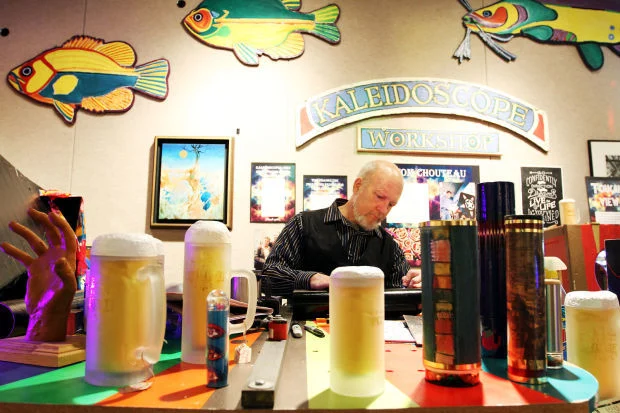
The colors, textures, lighting and seeing themselves reflected in designs along with flowers, stained glass, and more will create a mesmerizing experience guests won’t soon forget.

Legacy of Land: Treaties and the Shaping of America

September 19, 2026 thru February 7. 2027

As we celebrate our country’s 250th birthday in 2026, this educational exhibit explores how pivotal agreements transformed our nation’s landscape and communities. Presented in collaboration with the Smithsonian Institution and the Putnam Museum & Science Center, this exhibit highlights the Black Hawk Treaty of 1832, a defining moment that led to the founding of Davenport, Iowa. Through artifacts, documents, and stories, visitors will uncover the lasting impact of these treaties on the land and the people who called it home.

Dates are subject to change. Follow us on social media for current news and information!

The Etruscans

A GLIMPSE INTO ETRURIA

Before the Romans were the Etruscans, whose society flourished in central Italy during the 6th century BCE (Before Common Era). Their culture is known for its religion, language, art, trade, engineering, and architecture. They were skilled metalworkers known for their jewelry and bronze statues. They were expert engineers, developing mining, metal crafting, urban planning, road construction, and hydraulic engineering. Through trade, they exported pottery, precious stones, tools, and metalwork throughout the Mediterranean. The Etruscans had their own pantheon of gods and believed they received messages from the gods through divination.

Tomb of the Leopards, Tarquinai
Map of Etruria, World History Encyclopedia, 2013

FROM ETRURIA TO THE PUTNAM MUSEUM – MRS. ADAH MARTIN’S DEDICATED WORK DURING WWI

Adah Moore was born in Rock Island on July 17, 1868, and was the first woman to attend Augustana College. She married Wellington Martin in 1887 and had two daughters. Adah went to Italy in 1910 to support her daughter’s musical studies. When WWI broke out, Adah and her daughter joined the Red Cross. She was one of the founders of the American Hospital in Florence, Italy. Adah led the Red Cross factory in Tuscania where she recruited women to make clothing for refugees. For her essential work, she was given a gold medal and made a citizen of Tuscania. Adah was gifted several Etruscan artifacts by the Mayor of Tuscania, which she donated to the Putnam’s collections shortly before her death in 1921.

EXHIBITION CATALOG

Hercle Oinochoe (Wine Jug), 420-300 BCE

This oinochoe (wine jug) features the Etruscan god Hercle, a version of the Greek god Heracles. He was worshiped as a divine being and frequently depicted nude and beardless. The vessel likely shows Hercle defeating a bearded snake or in his Second Labor (the slaying of the Lernaean Hydra). Donated by Charles A. Ficke

Etruscan Bucchero chalice, 500-480 BCE

This Bucchero-stemmed chalice depicts a man in profile, possibly a wind god, based on the wing-like motifs on either side of the head. Bucchero pottery is an Etruscan manufacturing technique in which a black color appears through the restriction of oxygen during the kiln firing. The piece is then burnished to give it a glossy finish. A “V” carved into the base of the vessel may have been intentionally placed and could be an artist’s mark. Donated by Charles A. Ficke

Fibulae, 700- 600 BCE

“Leech” shaped fibulae (brooches) were worn during the 7th century BCE. Ones with long catch plates or tails on the end are believed to have been influenced by Etruria and have great detail and ornamentation featuring geometric patterns. Donated by Charles A. Ficke

Male Figurine, 400 BCE

This cast bronze figurine features a modeled hair knot at the back of the head- possibly a resting youth. Donated by B.J. and Mabel Palmer Estate

Male Figurine, 400 BCE

This cast bronze figurine may represent Hercle. Donated by Charles A. Ficke

Bronze Lunate Razors, 900-700 BCE

Lunate Razors were often found buried in Etruscan tombs. They were used for shaving, cutting hair, and funerary or religious practices. Putnam Museum Collection

Greek Etruscan Kylix, Drinking Bowl, 390- 370 BCE

This vessel features a seated woman holding a basket of unworked wool and timbrel (tambourine) in one hand and potentially a tapestry in the other. Donated by Charles A. Ficke

Thymiaterion, Incense Stand, 325 -275 BCE

The incense burner was likely used for religious practices and funerary rites. It has a female figure (caryatid) supporting the column, possibly representing the Etruscan goddess, Turan. It also features birds at the top and a cat catching a bird in the center. Donated by Charles A. Ficke

Pitcher, 1000, 500 BCE

The terracotta pitcher features an Aryballos (bulbous) shape and short neck. Donated by Adah Martin

Etruscan Cup, 1000-500 BCE

This orange terracotta cup is covered with black slip. Donated by Adah Martin

Etruscan Plate, 1000-500 BCE

This plate is orange terracotta with black glaze and features an incised geometric design. An “X” is scratched into the center. Donated by Adah Martin

Etruscan Plate, 1000-500 BCE

This plate is orange terracotta with a red-orange glaze. An “X” is scratched into the center. Donated by Adah Martin

Etruscan Kantharos, 550 BCE

This Etruscan bucchero-type handled cup is made of a burnished black metallic glazed terracotta. Donated by Charles A. Ficke

Animal Figurine, 600-400 BCE

This bronze ram figure has incised detail representing locks of wool. Putnam Museum Collection

SOURCES

Ambrosini, Laura. Thymiateria etruschi in bronzo: di età tardo classica, alto e medio ellenistica. Italy: L’Erma di Bretschneider, 2002.

De Puma, Richard Daniel. Etruscan Art in the Metropolitan Museum of Art. United Kingdom: Metropolitan Museum of Art, 2013.

Etruscan Italy: Etruscan Influences on the Civilizations of Italy from Antiquity to the Modern Era. United States: Museum of Art, Brigham Young University, 1996.

Haynes, Sybille. Etruscan Civilization: A Cultural History. Italy: J. Paul Getty Museum, 2000.

Shipley, Lucy. The Etruscans: Lost Civilizations. United Kingdom: Reaktion Books, 2023.

The Capital Campaign

A Reimagined Putnam!

The Putnam: Reimagined Capital Campaign is a multi-year construction and revitalization project that will touch nearly every area of the museum. The project includes a refresh of the front exterior of the building, a re-imagined Grand Lobby, and a revitalized home for the Science Center & Education department. A new museum-wide experience will ask guests to “Imagine Yourself” as an Archaeologist, Environmental Scientist, and several other jobs as they explore each of the Putnam’s unique galleries.

The Vault

The crown jewel of the Putnam: Reimagined Capital Campaign is The Vault. Utilizing a cutting-edge approach to collections management, guests will be able see much more of the museum’s substantial collection of over 250,000 items. Large, striking glass walls with extensive shelving, as well as peninsulas into the gallery and glass-enclosed storage islands allow for a behind-the-scenes look at items that have been previously unseen by the public.

Rendering of The Vault

New Interactives

The Vault will feature interactive experiences that will allow visitors to search the database for objects in the collection and learn more about the items that come from every continent in the world. There will also be an interactive that will give guests the chance to become a curator and design their own exhibit. Other new guest experiences made possible through this campaign include outdoor learning areas at the entrance plaza & south lawn and a Family Engagement Center for guests of all ages.

A new, refinished home for the Science Center

Some Projects are Finished

The museum has already successfully completed three major initiatives of the campaign: The World Culture Gallery, a reimaged more inclusive local history exhibit Common Ground: Our Voice, Our Stories, and the recently opened Quad City Innovator’s gallery. During the sponsored admission guests will be invited to share their opinions on the Quad Cities and weigh in on the projects underway at the Putnam, utilizing the newly updated community survey interactive within the Common Ground regional history exhibit.

A Message from the President

Cindy Diehl Yang, the President and CEO said about the project, “We are excited to have the public see what we are up to here on the west end. We are beyond grateful for the sponsorship from QCCT that will allow guests to see the amazing work that has already been completed and share their voice in the Putnam’s future. The Putnam truly is the community’s museum, and we want every Quad Citizen to be part of developing its future for generations to come.”

Contributions

While monetary gifts are the most direct way to support the campaign, guests can also support by purchasing Putnam merchandise. RAYGUN has released “WHO’S YOUR MUMMY?” shirts will be available at the RAYGUN website and the Putnam Museum Store. A portion of the profits will go directly to the museum’s Capital Campaign.

Who's Your Mummy? Raygun t-shirts supporting the Putnam Museum in Davenport, IA.

The current featured exhibit is Hubble Space Telescope: New Views of the Universe direct from NASA. The museum also features daily documentaries in the GIANT Screen Theater, as well as special feature films on Thursday evenings and throughout the holiday season. More about upcoming events can be found here or by following our social media.

Thanks to generous support from the Quad Cities Cultural Trust (QCCT), Putnam Museum & Science Center visitors will enjoy sponsored admission as they explore the museum at no-cost to them through January 5, 2025. The Quad Cities Cultural Trust is committed to the health and growth of the Quad City region, and a thriving arts and cultural scene is key to both. Their support of sponsored admission allows guests to give back to the Putnam, as the museum launches its Putnam: Reimagined Capital Campaign.

Pyramids of Giza and The Sphinx (Part 3)

Arrival at the Pyramids

You’ve probably heard about it before from other travelers – the high-pressure salesmen, the scammers, the crowds that pepper the site of the pyramids and Sphinx. What you’ve heard is true, but easily managed. On our way to the Giza pyramids, Ahmed warned us not to engage with the salesmen at the site. Don’t even acknowledge them. If they are persistent, only speak to tell them ‘no.’ Don’t touch anything they show you. Eyes forward, keep walking. Do not follow anyone anywhere. Stay within sight of the bus.

It was all a bit overwhelming, especially since it was the end of the day. We were all exhausted. At the site, we were one of a long line of buses. It seemed crowded, yet this was the “off” season – the HOT season. We were apparently very lucky for how few people were there.

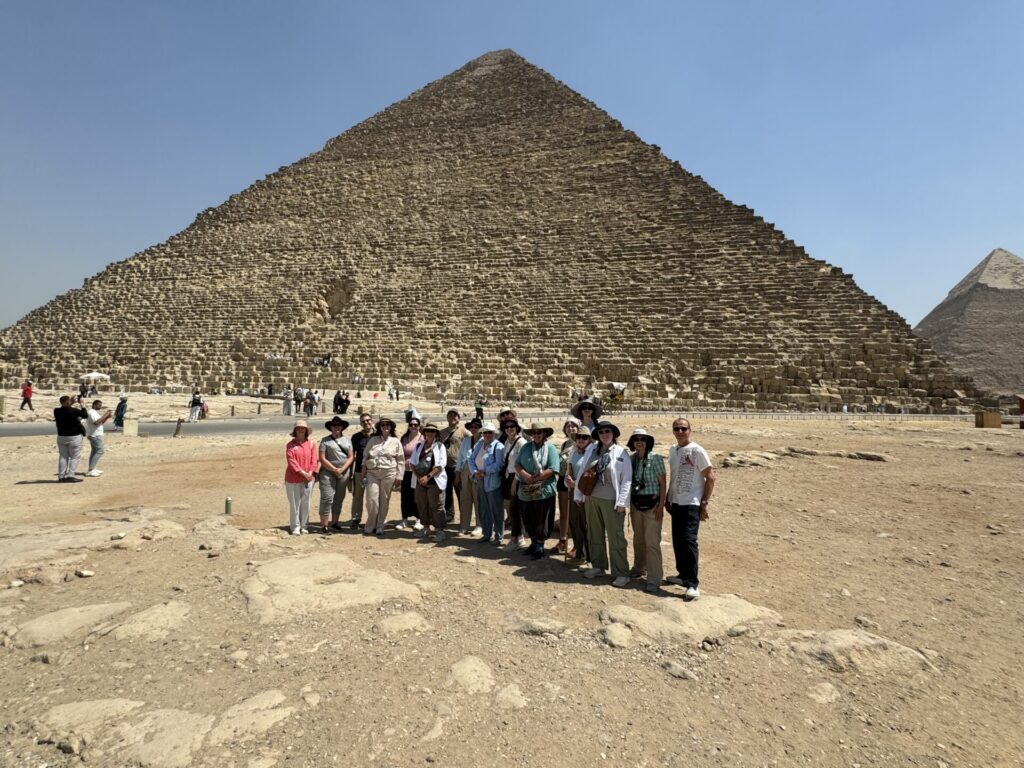
We started at the Pyramid of Khufu. It’s the largest of the three ancient structures. Behind it, we could see the beautiful pyramid of Khafre, Khufu’s son. Hidden from our perspective, was the pyramid of Menkaure, Khafre’s son, and The Sphinx.

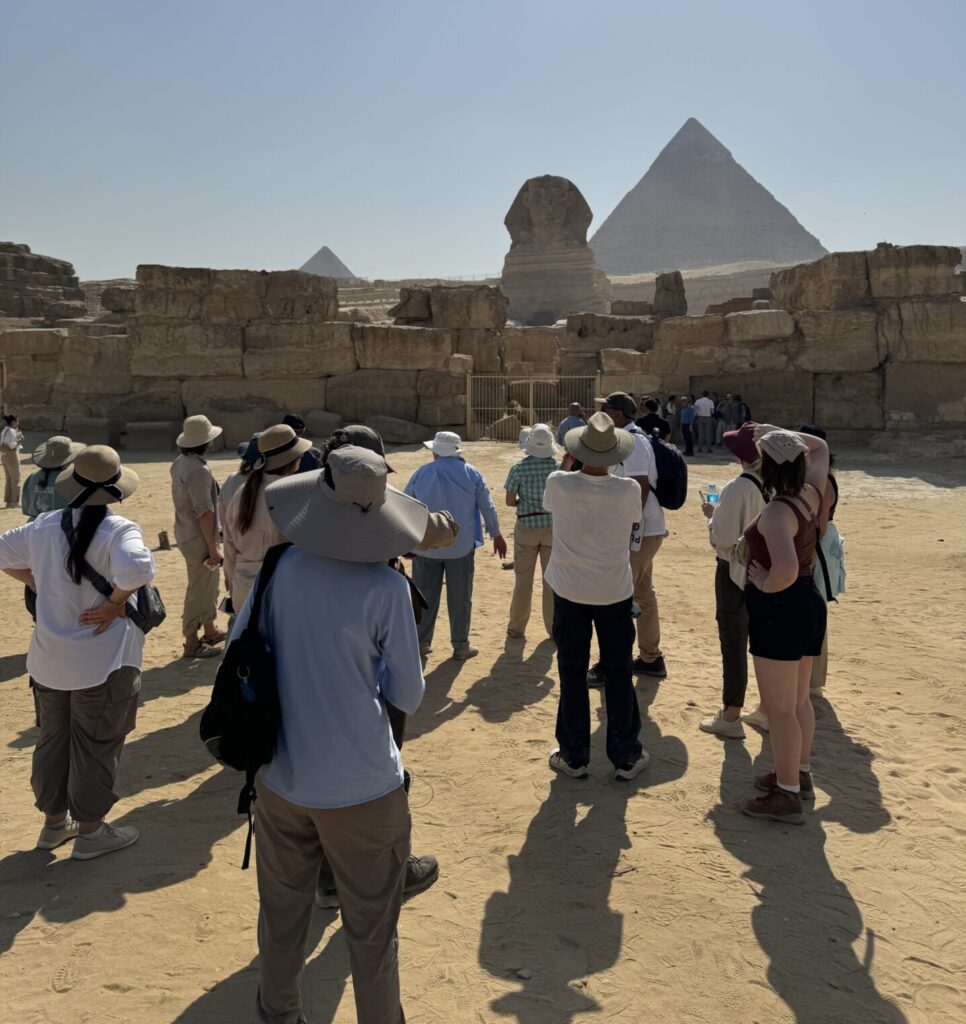
tour group at the great pyramid of giza

The Great Pyramid

The Khufu pyramid is well-known as a “Wonder of the World.” It is big, enormous. A staggering feat of labor, it stands around 449 feet high. An estimated 2.3 million blocks towered above us. Yet, it’s shrinking. When it was built, it was probably around 30 feet higher. Along with loosing its outer facing limestone, which gave it a smoother look, many blocks have been “repurposed” for other needs over the millennia. Khufu was the son of Sneferu, the pharaoh responsible for the Bent Pyramid and Red Pyramid. Khufu’s builders benefitted from Sneferu’s mistakes. This pyramid is the uncontested Great Pyramid, largest and most famous of all pyramids across the entire globe. Built 4500 years ago, it still amazes 21st century visitors.

The main walk from the ticket office to the pyramid is a built wooden path, but it is full of salesmen. As you pass, they hold their wares in front of your face. You’re encouraged to touch, feel, and hold their trinkets and gifts. Ahmed had explained this was common practice. If you touch or hold something, they may accuse you of agreeing to purchase it and demand payment.

It was the end of the day. We were tired. They were tired. One particularly persistent salesman kept trying to hand me an Egyptian cotton scarf. I tried my best Arabic “no,” and he mocked me for my attempt. However, he did leave me alone. Later, I learned I hadn’t really needed to use Arabic; the vendors understand “no” in every language. We went on to take an uneven, rocky path to avoid the rest of them.

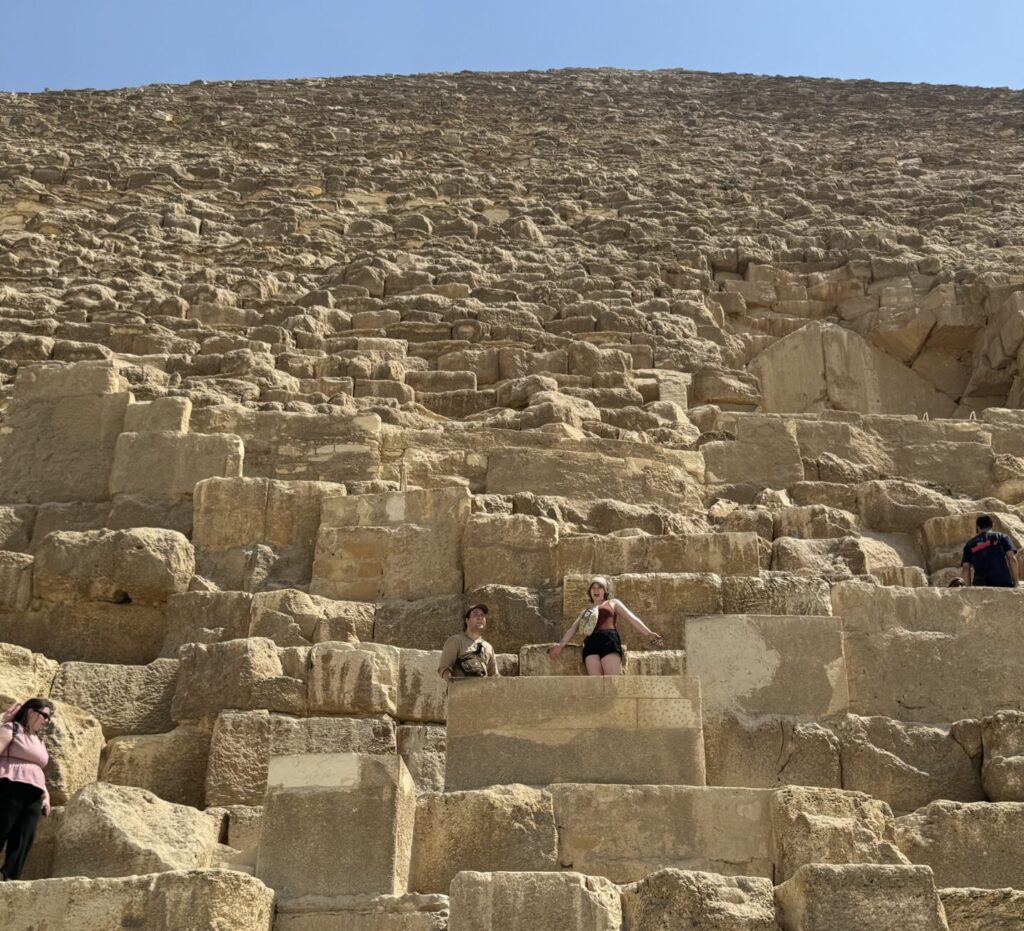
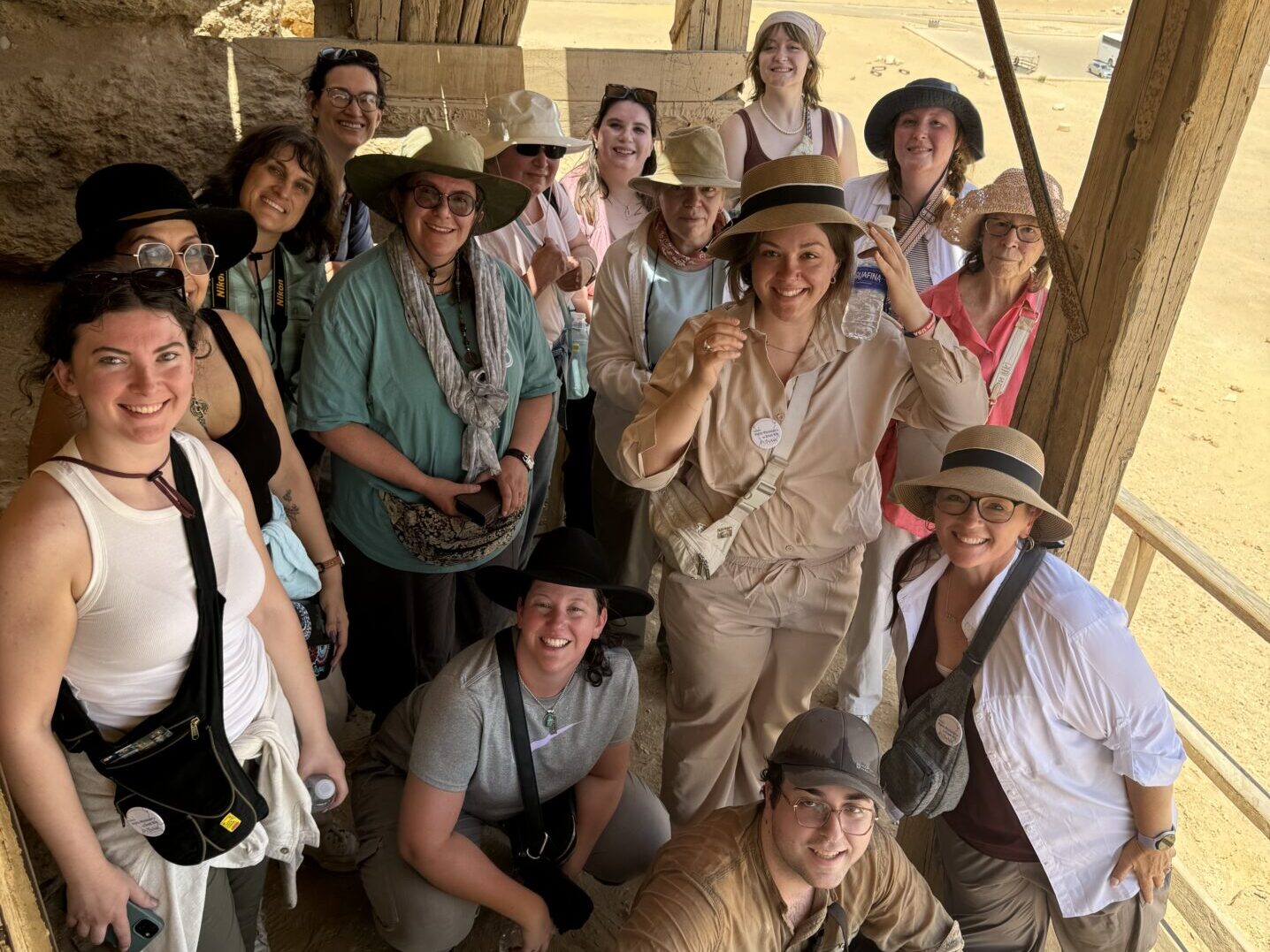
tour group on great pyramid


There is a small section of the pyramid of Khufu that you can climb up. A staircase follows the side up to an opening. Those who still had energy climbed up and we took pictures of them. I stayed on the ground. At the time, climbing another pyramid, even a short distance, did not seem worth it to me. The next day, I regretted it. But the thought of ascending the shadeless structure was just too much. Apparently, there is a gate at the top of the stairs. You could peek inside, but there wasn’t anything to see. We all tried to take photos that would reflect the scale of the monument, but it was impossible.

The Pyramid of Khafre

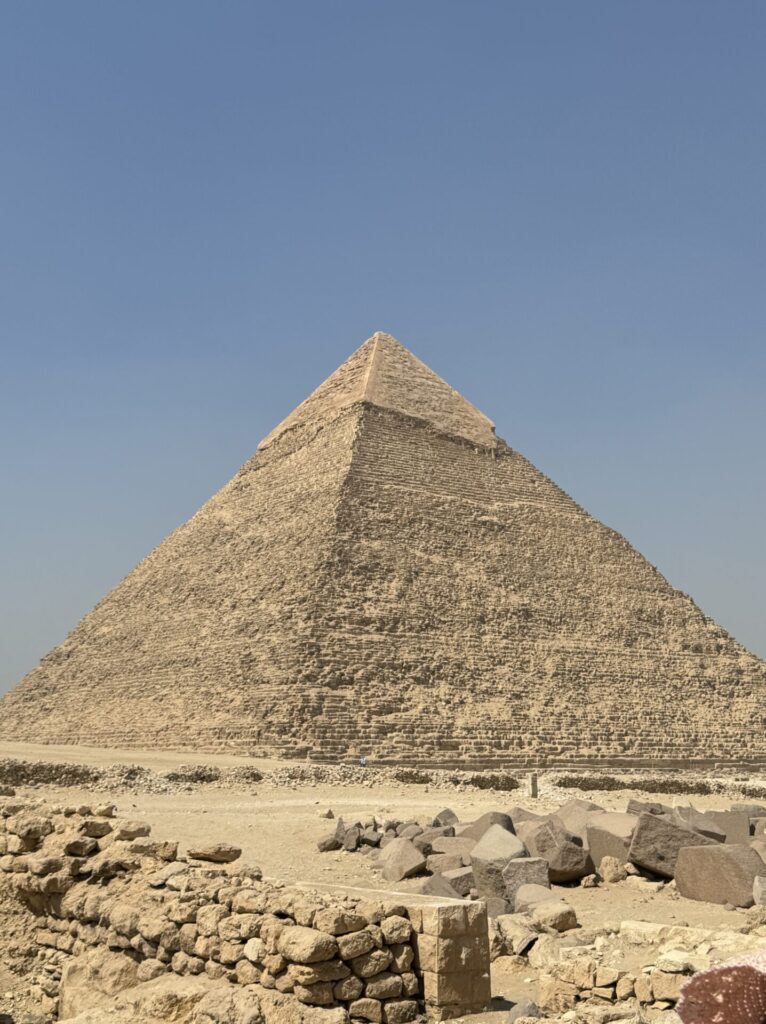
The Khafre pyramid was peeking from behind the Khufu pyramid. Ahmed went on to tell us about the history of the site. The Khafre pyramid is younger than its neighbor by one generation. Khafre was Khufu’s son, but not the expected heir. Historians don’t believe his older brother, Djedefre, lived long enough to succeed their father.

The Khafre pyramid still has some of the original limestone shell at the top. At one time, it covered all three pyramids. It gave them all a flawless look. In my opinion, Khafre’s pyramid was the most beautiful of the three.

The Pyramid of Menkaure

We got back on the bus and drove to the entrance of the pyramid of Menkaure. Of the three, it was the smallest, but we were able to explore it. After the Red Pyramid, the walk down the shaft didn’t seem like much of a challenge. Inside, it was humid, the walls were slick from breath and sweat. You could smell the tourists, so many had passed through every day that the prevalent odor was armpits. In the Red Pyramid, it was only decay and ammonia.

At the bottom were a couple of small, unadorned chambers. One had an arched roof, but nothing felt very exciting after our previous activities. Emerging out of the pyramid, we had a fantastic view of Khafre’s from across the plateau. For a few moments, I basked in their presence. This was the last pyramid we would visit during our trip. I was reluctant to leave, despite the exhaustion. But if you stand still for too long, the sellers start to crowd around. I gulped down nearly all my water and started back towards the bus.

Camel Rides

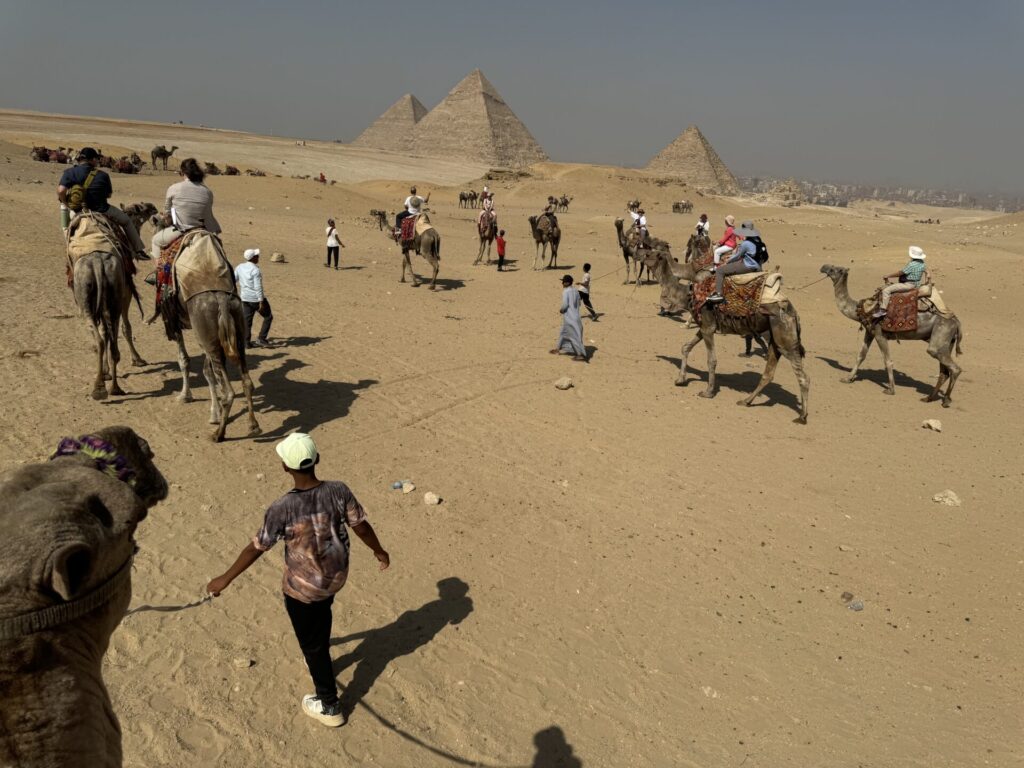
We headed to a nearby area which offered short camel rides across the sand. Here, you could take the quintessential Egyptian tourist photo: riding a camel across the dunes with the pyramids in the background. I was told all the camels had American names. There was Mickey Mouse, Elvis, even Rocky.

view of pyramids of giza from a camel

Yet, it should be mentioned, I’ve heard that German tourists are told the camels have German names, French tourists are told French names, so on and so forth. I, and a handful of other group members, elected to stay on the bus. Riding a camel was not an interest for me. I’d already ridden one at the state fair. It wasn’t an experience I was dying to repeat. Unlike the staircase of the Great Pyramid, I haven’t regretted this choice.

The Sphinx

After the riders returned to the bus, we took another short drive to the Sphinx. This was not what I expected, at all. I had heard how close the city has encroached upon the site.

There’s even an infamous Pizza Hut within view. Yet, I still had romantic notions regarding the enigmatic sculpture. We walked through a crowd of more sellers and along an old canal that’s being excavated. You can see part of its path. It seems to run in the direction of the Sphinx. Ahmed explained it was recently discovered, and Egyptologists now believe the blocks used to build the pyramids were carried to the site by rafts in the canal. It stops, apparently, right at the front paws of the Sphinx.

Shortly after this, we finally got a good look at the Sphinx – from behind a gate and walls. It was not accessible to the public to get closer. From where we stood, we could just see its head and shoulders.

No one is sure which pharaoh is responsible for the Sphinx, but a popular theory is Khafre may have commissioned it. The statue aligns so well with his pyramid complex. It might have served as an entry for ancient worshippers, as it was also next to his valley temple. Others say that Khufu is responsible for the Sphinx, and his son simply added on to it. Hopefully, further excavation will one day reveal the answer.

We had arrived at the Sphinx as the park was closing. The site guards hassled Ahmed to move us along. A special event was planned for the night, with what looked like a stage, spotlights, and a DJ booth. We took some quick photos after Ahmed’s lesson and walked back to the bus. And yes, almost directly opposite the Sphinx is a bright, colorful, Pizza Hut. One need only cross the street.

Read Egypt Travel Log (Part 1)

Read Egypt Travel Log (Part 2)

Stay tuned for Part 4!

See Egyptian History in the Quad Cities by visiting our Unearthing Ancient Egypt Gallery.

An Interview with our new President

Welcome to our new President and CEO!

In this interview with our new President and CEO, Cindy Diehl Yang, we sat down to ask the important questions, now that she’s settled into her new role here at the Putnam Museum and Science Center. You can watch the video here.

Getting To Know Our New CEO

What is your favorite exhibit?

“So far, my favorite exhibit has been the Innovator’s Gallery. Mostly because I’m not from the Quad Cities – and so every time I go in there, with one of the tours happening, somebody else tells me something that’s cool, that was invented in the Quad Cities. So, that’s been a huge amount of fun. I will say, I’m particularly fond of the washing machine because a son built it for his mom – Best Child Award, right there!”

What is your favorite snack at concessions?

“I have a couple of favorite snacks, so I can’t pick just one! A couple of the people downstairs talked me into trying the watermelon slushie – you should definitely try it – it’s like a Jolly Rancher Watermelon candy, and it is so good. And, I’m kind of a “3 o’clock M&M” fan – you know, it gets to be 3 o’clock and there’s got to be some chocolate – they have M&M’s, so, those would be my two biggest favorites.

Have you had a chance to see a movie?

“I haven’t had a chance to watch any of them yet. There is one that is in the rotations, that hasn’t come up yet but everyone keeps talking about, which is Superpower Dogs. So, I’m waiting for it to come back in the rotations so I can dip out to watch that one.”

What is your favorite part of your job?

“I just love my job, like I really do love my job. I like the fact that I’ve been meeting a huge amount of people in the community. I love how people love The Putnam – I say, ‘oh, I work with The Putnam,’ and they’re like, ‘I love The Putnam!’ So that’s always a great thing, you know. I think…building the connections. Building the connections internally, with the community – being able to build the connections with the past that we see in the exhibits. It’s just all that relationship building, it has been such a great, great part of what I do.”

What upcoming things are you excited for?

“It’s been really exciting – I can’t believe I’ve been here for 90 days, I’m really excited for the next 90 days. We’re just breaking ground on construction where we’ll be creating a vault of our collection that’s open for the public to see. And we’re so excited to have that under development and being able to put the great treasures we have on display for the public. We have over 250,000 items in the collection, with roughly 3 to 4% on display at any given time, and this will help up that, and also to be able to see more of the collection behind those that are pulled out on display. So, I’m pretty excited to be able to take part in seeing how that transforms and how it becomes something that the community can enjoy and appreciate on a regular basis.”


Thank you again to Cindy for sitting down with us! We’re looking forward to a new era of leadership at the Putnam Museum and Science, and so excited to have you on board.

The Serapeum and Red Pyramid (Part 2)

Serapeum, Catacomb of the Apis Bulls

The Sakkara Funerary Complex is known for the Step Pyramid of Djoser. Yet there are many more funerary sites spread across the area – many of them non-human! Included in these sites are catacombs of dogs, cats, baboons, and even hawks.

As we left the Pyramid of Unas, we loaded back onto our bus. The north side of the complex held the Serapeum, Catacomb of the Sacred Apis Bulls. I wasn’t sure what to expect; my memory had failed me on the details of this site. The term “Serapeum” was ringing a bell, but I couldn’t quite remember the significance. As we stepped out of the air conditioned bus, the blast of heat as we stepped down onto the sand felt more oppressive than before. The sun had grown much hotter than when we started that morning.

The Cult of Apis

The Cult of Apis was popular and long-lived in ancient Egypt. Actually alive, the Apis Bull was chosen each generation. It was considered the embodiment of Ptah, a god of creation and crafts. The bull’s movements and behaviors were interpreted as prophetic. Generally, the bulls lived long, happy lives. In the Late Period, their deaths even occasioned national mourning periods. After its death, the bull became the embodiment of Osiris, god of death, resurrection, and fertility. The Serapeum Catacomb was the final resting place for many of the beloved Apis Bulls.

Hieroglyphs in the Catacomb

The cult may have begun as early as the Pre-Dynastic Period of Egypt. The beliefs continued through the Ptolemaic Period. Later, the Romans even adopted Apis, named Serapis, into their own pantheon. Despite the long history of the cult of Apis, the Serapeum was a newer addition to Sakkara, although still ancient by our standards. Having been commissioned during the New Kingdom, it gained popularity through the Late and Ptolemaic Periods.

Into the Catacombs

Once we descended into the catacombs, Ahmed, our official guide, gave us a brief history of the site. Soon, we were on our own to explore.

Waiting in one of the corridors

After Ahmed’s brief lesson, I expected to see the burials of the Apis Bulls. However, what I did not expect was the sheer, monumental scale of their sarcophagi. A bull is a big animal, of course, but their granite sarcophagi are huge. It was shocking. With lids, they average about 60 tons. Parking an SUV inside the coffins looked like an easy feat. They were so large, it took 28 days of work for the ancient Egyptians to move a sarcophagus into the Serapeum Catacomb.

standing next to coffin in serapeum
Standing next to one of the giant sarcophagi

Walking down the main corridor, my mouth hung open. Awestruck, I couldn’t imagine the labor it took. When the Serapeum was excavated in the 19th century, French archaeologist Auguste Mariette found evidence of rollers and rails along the floor, along with winches at strategic points. These simple machines would help move the sarcophagi smoothly. Yet, it wasn’t a perfect operation. Some of the sarcophagi didn’t make it all the way to their resting places. Seemingly unfinished, an immense granite coffin laid in the middle of one of the corridors. Abandoned for millennia, it appeared to be too dang heavy.

Not far from the abandoned sarcophagus, we passed through a small chamber. Along the walls were many small niches. The living would come into this space to pray and make offerings.

A wall of offering niches

Lost to History

The Serapeum Catacombs were left behind, ignored, during the Roman Period. The Cult of Apis continued in the area, but they stopped burying their bulls in the complex. Later on, looters broke into the catacombs. They stole the riches entombed with the bulls, likely during the Christian Era. When Mariette rediscovered the site, only a couple sarcophagi were undisturbed.

When we descended into the depths, I wasn’t prepared to be so impressed. However, the Serapeum shocked me with its scale. There were so many ways the Egyptians could have memorialized the bulls. They could have continued to create individual, unconnected tombs. Yet, they dug a long, underground corridor with mechanisms to drag huge, granite sarcophagi that were nearly the width of the passage. The time, money, and effort they spent to honor the bulls was nothing short of incredible. To think, some Egyptian pharaohs didn’t even receive such opulent burials.

The Dahshur Pyramids

Once again, we climbed back onto our bus. The cushioned seats and crisp air conditioning felt luxurious. In a few minutes, we would visit Dahshur. This necropolis is famous for the Bent and Red Pyramids. Considered to be an ancient mistake, The Bent Pyramid was intended to be the resting place of Sneferu, a pharaoh of the Fourth Dynasty (roughly 2600 to 2500 BCE).

Sneferu’s Demands

The Bent Pyramid was supposed to be very tall, with a 54 degree incline. For reference, the popular Great Pyramid of Giza is slightly less steep, with only a 51.5 degree incline. The Bent Pyramid was too ambitious. Realizing it would collapse in on itself, the builders amended the angle halfway through. Therefore, its referred to as “bent” or “blunted,” because the top section turns into a 43 degree incline.

Generally, it’s believed that Sneferu was never laid to rest inside. Unhappy to see the modified angle of the Bent Pyramid, he demanded a new one with a smooth slope. Therefore, the construction of the Red Pyramid begun.

The Red Pyramid

It was destined to be Sneferu’s actual resting place. It was built of red limestone with an angle of about 43 degrees, the same as the top portion of the Bent Pyramid. Apparently, they decided to play it safe rather than sorry.

The Red Pyramid

We weren’t able to go inside the Bent Pyramid, but we could with the Red Pyramid.

But, it would not be an easily accessible entrance. First, we had climb about halfway up the outside of the pyramid, and then descend into it via a long, steep tunnel. To reach the Inner Chamber, we would climb another two to three stories. Then, of course, would be the return journey.

I was not feeling hopeful. Only our first day in Egypt, we had already traveled, walked, climbed, and seen so much. Yet, it was not even lunchtime yet! On top of that, I was exhausted from the heat, dehydration, and jetlag. All I wanted to do was lay down for a nap. I thought I had trained well for Egypt. Taking long walks in the Iowan heat and stairs at work (when I felt like it) had apparently not been enough. I could have spent endless hours on the Stairmaster and still not have been prepared for this.

red pyramid outside
A long ascent

I wasn’t alone in my caution. But, we dragged ourselves out of our seats and walked across the sandy plain under the harsh sun. Up the side of the pyramid, the steps were uneven from years of wear. Eventually, there was a rail to hold onto. We took frequent breaks on small landings. At the top of the stairs, an unofficial guide was stationed along with an awning and benches to rest. We looked across the sandy vista. Peeking up along the horizon, we could see the Step Pyramid from earlier in the day.

After a few minutes of catching our breath, we prepared for our descent. Our group split into those who would go on and those who would stay behind. I decided to go for it.

The Descent into the Pyramid

Onnica explained the best way to proceed was to go backend first, as if descending a ladder. Inside, there were not proper stairs. There was only a wooden floor with railings to grab onto. The wooden planks formed a long ramp with perpendicular planks raised every few feet to provide foot holds.

The passage into the Red Pyramid

If you fell, you would bounce all 200 feet down, with little to stop you except other visitors. The passage is only about 3 feet tall, so you have to stoop as you go. To look down, you have to turn and peek over your shoulder – not recommended. We went down blind.

Our group worked together as we moved down the passage. Shouting up, we alerted each other when the ceiling height changed or if there was a slippery section. Each person had eyes on the person above them. If one fell, there would be a domino effect. So, we took our time.

Now, if you’re thinking “at least they were out of the sun,” – I have news for you! Inside, the air was no relief. Yes, the sun was not beating down, but it was like stepping inside an oven. Everything was close and concentrated. There was a metal duct running down the side of the “stairs” in an attempt to pull fresh air into the suffocating heat and stink of the interior chamber. But, it didn’t seem to have much effect. The descent seemed to go on and on.

Reaching the Bottom

It was a relief to hit flat ground, albeit with shaking legs. My sweat mixed with sunscreen and dust; it ran into my eyes. We moved through a couple of chambers, but I don’t remember much about them. I was recuperating and drinking water. We came to a taller chamber with a wooden staircase. Rising up the wall, it met an opening that would be nearly impossible to reach otherwise.

A certain scent became more and more pervasive as we climbed the wooden stairs. It was becoming more difficult to breath. We went slowly, leaning heavily on the rails. There was another unofficial guide at the top of the stairs who guided us down a short path to another chamber. He warned us it would be very stinky.

Since not all of us would fit inside, we took turns. I waited and attempted to catch my breath. As others in our group took a few steps forward into the chamber, they immediately began gagging. It already smelled pretty bad, I couldn’t imagine it being much worse inside. Everyone took only a few steps in before taking a quick photo and immediately turning around to leave.

The Inner Chamber

Someone said, “Just a bunch of rocks and bats.” Oh. Soon, it was my turn. I walked forward, edging along the narrow tunnel. The smell was definitely getting worse. Another passed me on their way out, coughing, “See if you can hold your breath.” It was like a wall of heavy, thick ammonia. I closed my mouth and tried not to inhale. I looked up the 50 foot corbelled ceiling.

The peak of the 50 foot corbelled ceiling

The pyramid stone was stacked neatly. I didn’t want to think of how many tons of rock was being held over me. Looking over a railing, we saw tumbled rocks at the bottom. I took a breath and immediately regretted it.

After snapping a couple blurry photos, I exited the chamber. I took a deep breath of air. It felt so much fresher than it had, only a few minutes before. I didn’t seen any bats, but the chamber was dark and I wasn’t wearing my glasses. But, by smell alone, I knew they were in there. I had read of bat guano (feces, for the uninitiated) being compared to ammonia, but I had never experienced it before. Since returning, I learned the scent only gets stronger with decay. I’m not sure how many years bats lived inside the chamber. Based on smell alone, they’ve been there since the pharaoh himself.

Climbing Back

Breathing as deeply as I could, I tried not to think about the climb back up to the entrance. We walked through the initial chambers. As we retraced our steps, we exchanged comments with other tourists.

Then, the ascent began. The climb seemed interminable. A few times, I thought I wouldn’t be able to make it. But, there wasn’t anywhere to rest or step aside for others to pass. Once you started, you had to finish. We took our time and patiently waited as people in front of us needed to stop for breath. Soon, we would be the ones needing respite.

Fresh Air

Looking back, I feel proud of myself to have made it. I’m not athletic and my twenties are far behind me. The whole way, I was huffing and puffing. When the sunlight became visible, I felt faint. My hands were numb and my legs were jelly. Had the air gotten even more stuffy since our descent? Yet, eventually, I was able to poke my head out of that pyramid. I took a big, triumphantly deep breath. Recounting the trip, I told my friends it might have been one of the most physically challenging things I have ever done.

We waited for the rest of the group to finish the climb. Looking out over the site, I was enjoying the occasional breeze. We joked around with the guide at the entrance. He was helping everyone onto the ledge when they emerged from the passage. Glowing with sweat and excitement, we thought about our first pyramid climb in Egypt!

If I could tell my teenage self that one day, I would do this, I don’t think she would have believed me.

We rested and gulped water laced with electrolytes on the that ledge. Looking at the rough staircase below, bus in the distance, we wondered, “Had it been so far away when we first approached?”

Read Egypt Travel Log (Part 1) – The Sakkara Necropolis and Step Pyramid

Continue to Part 3 – The Pyramids of Giza and The Sphinx

See Egyptian History in the Quad Cities by visiting our Unearthing Ancient Egypt Gallery.

Community Access Pledge Form

I Want to Invest In Our Community Access!

With the Community Access Fund, you support education and learning outside of the classroom for children in the Quad Cities.

A donation to our Access Fund helps to support:

  • A museum trip for a low-income household
  • Educational camps/workshops for children who otherwise couldn’t afford them
  • Field trips for students with financial need
  • Other opportunities to help our community access the Putnam!
Community Access Fund Pledge Card
My gift will be fulfilled in the following manner:
Credit Card Information
Card Number
Month
Year
CVC
Send checks to:
Putnam Museum & Science Center
Attn: Community Access Fund
1717 West 12th Street
Davenport, IA 52804

For more information, please contact Betsy Matt Turner, Vice President of Strategic Advancement, at 563-336-7303 or bturner@putnam.org

We Want To Hear From You!

Let us know what you think

Take this quick survey to help us improve our museum.

Putnam Attendance Survey
Are you 18 years of age or older?
Have you visited the Putnam Museum & Science Center in the last 10 years?

Discovery Dome

An Immersive Planetarium

Step into The Discovery Dome, where the cosmos comes alive right before your eyes! This immersive, inflatable e-planetarium offers a unique opportunity for visitors of all ages to kick back and embark on a journey through the stars, galaxies, and beyond.

Discovery Dome shows will be available once a month for a $4 add-on to your general admission, or $5 to just experience the Discovery Dome show.

You can find future dates here.

Upcoming Discovery Dome

  • No events

Egypt Travel Log (Part I)

From Nora Moriarty, our Assistant Curator:

Over a year ago Onnica Marquez, Archivist and Assistant Professor at St. Ambrose University (and former archivist at the Putnam Museum) sat down to lunch at a local restaurant with me and the two Putnam curators following her first visit to Egypt. Glowing with excitement and enthusiasm, she recounted her adventures. She described it as “the trip of a lifetime”, and it sure sounded like it was.

As she told her tales, I thought about my own dormant interest in traveling to Egypt. Once upon a time I had fancied the idea of becoming a full-time archaeologist who would excavate in Egypt and have lots of novel-worthy adventures myself, but real life got in the way, and I happily settled into the museum field and curatorial work. Intrigued, I wondered if I would ever get the chance to experience an Egyptian adventure like Onnica’s.

The Plan Unfolds

It wasn’t long before conversations started about a possible Putnam-sponsored group trip to Egypt. Some museums offered guided vacations, but I had never been on one myself. Onnica came to the Putnam to give a presentation about her trip, made up of much more in-depth explanations than she told us over lunch -and it included high resolution photos! The colors were vibrant and the images larger than life in our GIANT Screen Theater. Once again, I thought wistfully of traveling to Egypt and seeing these sites in person.

The idea gained traction and it wasn’t long after this that the Putnam announced there would indeed be a sponsored trip to Egypt, led by Onnica herself. I was excited at the prospect, but I hesitated thinking about the logistics, the time, the cost… I thought about how long it had been a dream of mine to see Egypt, and how watching Onnica’s presentation had brought back my passion for Egyptology. Not long after, I crossed paths with her at the QC Archives Fair. We had a conversation about how fun it would be to go with a group of museum and library staff members who all had deep interests in history. Onnica was so enthusiastic and encouraging, That night, I did the math: vacation time, savings…I had the opportunity. Excitement grew within me as butterflies filled my stomach. This was my chance to go, I had to take it!

Arrival In Egypt

A few months later, I was on a bus driving from Cairo to Giza, staring out the windows and marveling at the sights. We rounded a curve on the highway and saw our first glimpse of the Great Pyramid – just the top peeking between modern apartment buildings. This was my first time seeing the last surviving site of one of the Seven Wonders of the Ancient World.

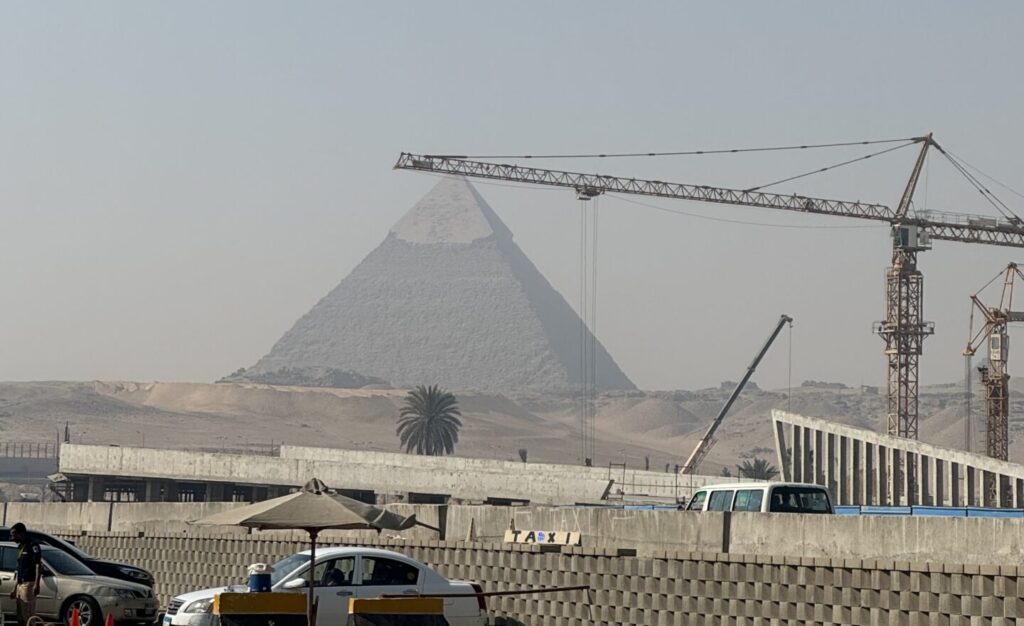
I attempted a few photos through the windows of the bus. Our guide Ahmed El Mounir reminded us, laughing at our excitement, that we would visit the pyramids soon and get much better photos. Yet there seemed, in the moment, to be something important about recording that first peek. It all became a bit funnier in a few minutes, when we pulled into our hotel’s driveway: just across the highway from the very same pyramid! We had a clear shot of the three largest pyramids of Giza from our front door (with a modern crane marking the plaza construction of the new Grand Egyptian Museum in the foreground). None of us could believe how close we were! We knew we would see them up close and personal the next day, but we had a night of rest ahead of us at our hotel before striking out to see the sights.

Day One

The morning we visited the Sakkara (also spelled Saqqara) necropolis was unsurprisingly hot and sunny. What did surprise us that first morning in Egypt was the haze over Giza – part smog, part dust from the desert. Trying to see far off into the distance was a challenge as we squinted to find the various pyramids across the horizon. We had been warned about dehydration and stocked up on hydration packets for our water bottles. Now, we were ready for the dusty climbs through pyramids and across uneven ground.

The famous Step Pyramid (also known as the Pyramid of Djoser, circa 2650 BCE) was in view as we drove up the incline to the plateau. There, we would spend a few hours at the pyramid and surrounding sites before moving on to Dahshur, another nearby necropolis.

Sakkara Necropolis

The necropolis was used in the Old Kingdom and New Kingdom for entombing and memorializing nobles and royalty. It served the ancient capital city of Memphis. It is the first true pyramid in the world, designed by the architect and high-priest Imhotep in the Third Dynasty, who had the idea to stack the traditional single-story tombs, or mastabas, one on top of another, forming a rudimentary version of the monumental shape we call a pyramid. Imhotep was later deified in the Ancient Egyptian religion.

You approach the pyramid and plaza through a columned hall at the southeast end of the complex. The doorway is rather narrow for a monumental entry. As we entered, we were encouraged to touch the walls on either side, to feel how smooth they were from so many humans passing through the same space over millennia. The hall was interesting in that the 40 columns were not freestanding. Instead the walls on either side jutted out to meet the sides of the columns, creating niches between each set.


Approaching the Plaza

The niches were likely for statues of gods, maybe representing the ones a pharaoh must answer to upon death. We imagined how intimidating a concept this must have been – to pass by each god who stands in judgement, needing to answer each honestly and accurately before achieving immortality. The columns rise up in such an enclosed place that it was a relief to step into the sunshine and be greeted by the sight of the Step Pyramid across the sandy plaza.


The plaza in front of the Step Pyramid was used by the Pharaoh to demonstrate his fitness and ability to lead during the ancient Sed Festival, similar to British “Jubilees.” The festival typically began 30 years into his rule, then happened every few years after that. The Pharaoh would run around the open plaza in front of the pyramid. There are even some ancient depictions of this event showing the Pharaoh in a splayed running stance. It’s hard to imagine modern political leaders being forced to perform athletic feats to legitimize their power.

The Pyramid of Unas

The Step Pyramid was not one we could enter, but the nearby Pyramid of Unas was open to visitors. We climbed from the plaza and walked past various mastabas while locals tried to sell us cold drinks and souvenirs.

The Pyramid of Unas looks more like a mound of rubble than a proper pyramid. Ahmed explained he was not allowed inside the chambers with us – a common occurrence in tighter spaces around Egypt. When you enter, there are “unofficial guides”, who will help you with photos and explain the site for a modest tip.

We slowly descended down a narrow and low-ceilinged passage. It would have been much easier if I wasn’t clutching a water bottle in one hand and my phone, camera ready, in the other. We were told that this would be one of the easier climbs of the day.


Unas was a pharaoh of the Fifth Dynasty (died circa 2315 BCE). He’s recognizable by a distinctive cartouche: a simple design containing a rabbit. Unas is also notable for having the oldest known example of ‘pyramid texts’. These hieroglyphs, which are carved in the interior chamber walls from floor to ceiling, are religious texts (spells) that aid the pharaoh in the afterlife.

In the Burial Chamber

An unofficial guide showed us the sarcophagus of Unas before turning off the lights. He held a flashlight to the wall, explaining that the walls were lined with alabaster. They glowed with the small circle of light. Next, he told us to get our cameras ready for a magic trick. He grinned while he held the flashlight sideways, flush to the wall, which caused the beam of light to skim the surface of the alabaster.

It revealed an image of the pharaoh in subtle, near-invisible relief! With the lights on, we would have never known there was one on either side of the sarcophagus. The pharaoh is shown in idealized form; strong, tall, in a position of smiting his enemies. This moment, which some of us had only heard about, earned a series of gasps and “oohs” from everyone. My photos do not do it justice.

There was something magical in the moment: standing inside the first pyramid I had ever entered, surrounded by religious texts of people who lived over four millennia ago, in the final resting place of a long-dead ruler, watching as shadow people appeared on the wall. It doesn’t take much to put yourself in the shoes (sandals?) of an ancient Egyptian who would have similarly marveled at the feat.

I felt a bit dazed returning to the fresh air after that. We started trekking back across the site, stepping gingerly to avoid camel droppings. We loaded back onto the bus to visit the Serapeum. I had severely underestimated this next site, with only the vaguest memories of briefly studying it back in college. Soon, I was awed again by the accomplishments of the ancient people who created it. 

Continue to Part 2 – The Serapeum Catacomb and Red Pyramid.

Learn more about the Saqqara Necropolis here.

See Egyptian History in the Quad Cities by visiting our Unearthing Ancient Egypt Gallery.